48-Port Managed Network Switches
A 48 port switch in this category is managed, rack-mount enterprise hardware for dense access closets and top-of-rack server rows, with access ports at 10/100, 1G, 10G or 25G. Gigabit 48-port models come from the Cisco Catalyst and Juniper EX families, and 10G and 25G models for server racks from Cisco Nexus, Juniper QFX and Dell's S-series. Each one is tested in our lab and backed by a 2-year warranty.
-
 Juniper QFX5100-48T-AFI 48 Port 10GBASE-T Layer 3 Reverse Airflow SwitchAvailability: Available by QuoteManufacturer: Juniper Condition: New 2 Year WarrantyRequest PricingOut of stock
- Juniper QFX5100-48T-AFO 48 Port 10GBASE-T Layer 3 Normal Airflow SwitchAvailability: Available by QuoteManufacturer: Juniper Condition: Refurbished 2 Year WarrantyRequest PricingOut of stock
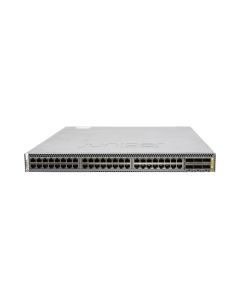


The access speed decides the job
At 48 ports, gigabit models connect desks, phones and access points, and 10G and 25G models connect servers at the top of the rack. The uplinks scale with the access speed, according to the makers' data sheets:
| Access ports | Uplinks the makers pair with them | Where the switch sits |
|---|---|---|
| 48 x 1G | 2 or 4 x 10G SFP+ | Campus and branch access |
| 48 x 100M/1G BASE-T, data center model | 4 x 1/10/25G SFP28 and 2 x 40/100G QSFP28 | 1G server and management networks |
| 48 x 100M/1G/10GBASE-T | 6 x 40G QSFP+ or 6 x 40/100G QSFP28 | Copper-attached servers |
| 48 x 1/10/25G SFP28 | 6 x 40/100G QSFP28 | Servers at 25G |
The 48-port Catalyst 9300 works differently: it takes a modular uplink, and Cisco's default C9300 configuration does not include a network module, so name the module you need when you request a quote. Cisco's StackWise-480 joins up to eight C9300 switches with 480 Gbps of stack bandwidth.
Browse by brand in Catalyst 9300, Cisco Nexus 9000, Juniper and Dell Networking, or see the 24-port, 10GbE, managed gigabit and PoE+ switch pages under enterprise network switches. 48-port switches go out by FedEx Ground free of charge across the lower 48 states.
PoE budget and redundant power
A 48-port PoE switch often cannot power every port at the class maximum at once. Cisco's Catalyst 2960-X allocates PoE dynamically up to 740 W of PoE+, about 24 ports at 30 W, and its 48-port Catalyst 9300 UPOE models deliver the full 60 W to up to 30 ports. Power supplies vary by family:
| 48-port family | Power supply design (data sheet) |
|---|---|
| Cisco Catalyst 2960-X | One fixed supply, with an external RPS 2300 redundant power option |
| Cisco Catalyst 2960-XR | Dual redundant supplies; one ships by default |
| Cisco Catalyst 9300 | Dual redundant supplies, one by default, plus StackPower pooling across a stack |
| Cisco Nexus 9300 | 1+1 redundant hot-swappable supplies; no redundancy on 110V input |
48-port switch questions
- What happens when a 48-port PoE switch runs out of PoE budget?
- It stops powering ports in priority order. Juniper's EX switches cut power to low-priority ports before high-priority ones, with every port low priority by default and lower-numbered ports winning ties, so set high priority on phones and access points that must stay up. Cisco allocates PoE dynamically up to the budget, 740 W on a full-budget 2960-X.
- Do 48-port switches have redundant power supplies?
- Many do, but not all. Cisco's Catalyst 9300 and 2960-XR take two field-replaceable supplies, shipping with one, and Nexus 9300 switches run 1+1 hot-swappable supplies, though not redundantly on 110V. The Catalyst 2960-X has one fixed supply and relies on an external RPS 2300 for backup. Check the power option on each listing.