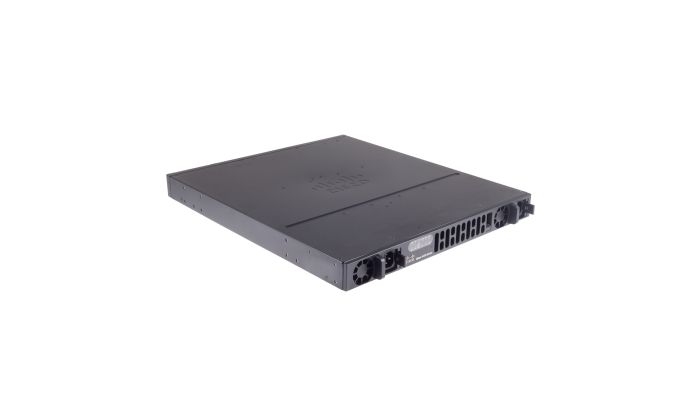
Five times the default rate of a bare ISR 4331 is what the Cisco ISR 4431 delivers: 500 Mbps before any licence, with 4 onboard Gigabit Ethernet ports, 3 NIM slots, split 4 GB control-plane and 2 GB data-plane DRAM, plus 8 GB of flash. No SM-X service-module slot is fitted to this platform, which is the trap for anyone stepping up from an ISR 4351. Cisco no longer sells it new, and the secondary market is where it is bought.
Ports, slots and memory
Onboard connectivity on the ISR 4431 is 4 Gigabit Ethernet ports, with 3 NIM slots, 1 ISC slot and no SM-X service-module slot at all. Memory architecture also changes at this point in the range: instead of the single combined 4 GB pool used by the 4300-series platforms, the 4431 carries 4 GB of control-plane DRAM plus 2 GB for the data plane, and onboard flash doubles from 4 GB to 8 GB. Anyone migrating from an ISR 4351 needs to know about the missing service-module bay before ordering rather than on the day of the cutover.
| Specification | ISR 4431 |
|---|---|
| Onboard Gigabit Ethernet | 4 |
| NIM slots | 3 |
| SM-X slots | 0 |
| ISC slot | 1 |
| Default DRAM | 4 GB control plus 2 GB data |
| Default flash | 8 GB |
| Default IPv4 forwarding throughput | 500 Mbps |
| With Performance licence | 1 Gbps (FL-44-PERF-K9) |
| With Boost licence | 3.4 Gbps @ IMIX (FL-4430-BOOST-K9) |
Throughput and the performance licence
A Cisco ISR 4431 forwards IPv4 traffic at 500 Mbps by default, 1 Gbps with the FL-44-PERF-K9 performance licence, and 3.4 Gbps at IMIX with FL-4430-BOOST-K9. Cisco publishes the Boost figure in Table 8 of the ISR 4000 data sheet and labels the row "IPv4 Forwarding Throughput", the same row to check on any competing listing.
The default rate is already five times that of a bare ISR 4331, which is the reason this platform is chosen for gigabit-class sites. The same rule still applies as everywhere else in the series: nothing on the chassis reveals the installed tier, and Cisco's performance and Boost licences are end-of-sale with no replacement product available, so a 500 Mbps unit stays a 500 Mbps unit unless it already carries the licence.
Cisco lists the same performance licence part number, FL-44-PERF-K9, for both the ISR 4431 and the ISR 4451-X, while the Boost part numbers differ — FL-4430-BOOST-K9 on the 4431 and FL-44-BOOST-K9 on the 4451-X. Those are the part numbers as Cisco lists them, and a shared part number should not be read as a statement that an entitlement moves between the two platforms.
Which software bundle you need
Software bundle suffixes on the ISR 4431 describe the entitlement the router was originally built with, and they are a separate axis from the throughput licence. Five bundles are held for this platform: Base, SEC, V, VSEC and AXV. Application Experience builds already contain Security, so where an AX-suffixed unit is under consideration, a separate Security entitlement layered on top of it pays twice for the same capability.
| Suffix | Bundle | Cisco part number |
|---|---|---|
| Base | IP Base only | ISR4431/K9 |
| SEC | Security bundle | ISR4431-SEC/K9 |
| V | Unified Communications | ISR4431-V/K9 |
| VSEC | Security plus Unified Communications | ISR4431-VSEC/K9 |
| AXV | Application Experience plus Unified Communications | ISR4431-AXV/K9 |
The suffix describes the software bundle the unit was originally built with. It is not a promise that a used unit still carries an installed throughput licence — that is confirmed per unit on the quote.
Module slots: what this router can take
Module capacity on the ISR 4431 is 3 NIM slots and 1 ISC slot, with zero SM-X service-module slots. That is the trap on this platform, and it is counter-intuitive enough to be worth stating twice: the 4431 is larger and faster than an ISR 4351 but cannot host a service module the 4351 hosts two of. A build that depends on SM-X modules has to use an ISR 4351 below it or an ISR 4451-X above it. Specific NIM part numbers are confirmed against your requirement before the order rather than listed here.
Where the ISR 4431 sits in the series
The ISR 4451-X matches the 4431's four Gigabit Ethernet ports and three NIM slots, doubles the licensed forwarding rate to 2 Gbps, and restores the two SM-X slots the 4431 does not have.
| Specification | ISR 4351 | ISR 4431 | ISR 4451-X |
|---|---|---|---|
| Onboard Gigabit Ethernet | 3 | 4 | 4 |
| NIM slots | 3 | 3 | 3 |
| SM-X slots | 2 | 0 | 2 |
| Default DRAM | 4 GB combined | 4 GB control plus 2 GB data | 4 GB control plus 2 GB data |
| Default flash | 4 GB | 8 GB | 8 GB |
| Default IPv4 forwarding throughput | 200 Mbps | 500 Mbps | 1 Gbps |
| With Performance licence | 400 Mbps | 1 Gbps | 2 Gbps |
| With Boost licence | 2 Gbps @ IMIX | 3.4 Gbps @ IMIX | 3.8 Gbps @ IMIX |
Stepping down to the ISR 4351 costs a Gigabit Ethernet port and drops default forwarding from 500 Mbps to 200 Mbps, but buys back 2 SM-X service-module slots and is the cheaper platform for module-heavy branch builds. Stepping up to the ISR 4451-X keeps the same 4 Gigabit Ethernet ports, 3 NIM slots, split memory and 8 GB of flash, doubles forwarding at every tier, and restores the 2 SM-X slots. A bare 4451-X forwards at 1 Gbps, which is exactly the licensed ceiling of a fully licensed 4431 — a comparison worth running before paying for a performance tier on this platform. Sites sized well below 500 Mbps are usually better served by the ISR 4331, and the wider catalogue of refurbished Cisco switches and routers covers the switching side of the same build.
Lifecycle and support horizon
Cisco no longer sells the ISR 4431 new, which is why the secondary market is where this platform is bought. End-of-sale is not the same as end-of-support, and the two are routinely confused in a way that costs buyers money in both directions: a router nobody sells new can still be a supported, current production asset, and the discount that comes with end-of-sale status is the reason refurbished units make sense at branch scale. The exact milestone dates published for this platform are confirmed on request rather than quoted here, because the applicable Cisco notice covers a named subset of the 4400-series part numbers and we do not publish a date we have not matched to the exact part number being sold.
Cisco's notice on the performance and Boost licences records that no replacement product is available. That governs how a used ISR 4431 should be specified, because it means the throughput tier travels with the individual unit rather than being something that can be added once the router is in service.
Condition, testing and what ships with the router
Every ISR 4431 we ship is refurbished enterprise networking hardware, tested when it arrives and tested again before it leaves. The process is fixed: inbound test on receipt, disassemble, clean, inventory, pick, assemble, configure, and a final outbound test before the unit is packed. Routers ship with a 2-year Enterasource warranty and free FedEx Ground delivery to the lower 48 states.
Software licences and subscriptions are not included unless the listing states otherwise. Cisco's throughput performance and Boost licences for this platform are end-of-sale with no replacement product available, so a licence cannot be purchased new from Cisco after the fact. Tell us the forwarding rate your circuit needs before you order and we will confirm, in writing, what the specific unit we are shipping carries.
Frequently Asked Questions
What is the throughput of a Cisco ISR 4431?
A Cisco ISR 4431 forwards IPv4 traffic at 500 Mbps by default. With the FL-44-PERF-K9 performance licence installed it forwards at 1 Gbps, and with FL-4430-BOOST-K9 it reaches 3.4 Gbps at IMIX, the figure Cisco publishes in Table 8 of the ISR 4000 data sheet. The default rate alone is five times that of a bare ISR 4331, which is the main reason this platform is specified.
Does a refurbished ISR 4431 come with a performance licence?
Assume not unless the listing states otherwise. A bare ISR 4431 forwards at 500 Mbps, and 1 Gbps requires FL-44-PERF-K9 to be present on the unit that ships rather than added afterwards. Cisco's performance and Boost licences for this platform are end-of-sale with no replacement product available, so that tier cannot be purchased new later. Tell us the rate your circuit needs and we put the answer in writing.
What is the difference between ISR4431/K9 and ISR4431-SEC/K9?
The suffix identifies the software bundle the router was originally built with. ISR4431/K9 is the IP Base build; ISR4431-SEC/K9 adds the Security bundle. V carries Unified Communications, VSEC combines Security with Unified Communications, and AXV is Application Experience with Unified Communications. Application Experience builds already contain Security, so adding a separate Security entitlement to one pays twice for the same capability.
Is the Cisco ISR 4431 end of life?
Cisco no longer sells the ISR 4431 new, which is why it is sourced on the secondary market. End-of-sale status is separate from end-of-support status, and a platform can be well inside its support horizon while no longer being orderable from the manufacturer. The exact milestone dates that apply to this specific part number are confirmed on request rather than published here, because the relevant Cisco notice covers a named subset of the 4400-series routers.
Does the ISR 4431 have an SM-X slot?
No. An ISR 4431 has zero SM-X service-module slots. It carries 3 NIM slots and 1 ISC slot, and that is the full extent of its module capacity. This surprises buyers migrating up from an ISR 4351, which has 2 SM-X slots, because the larger and faster platform is the one that cannot host a service module. Builds that need SM-X modules use an ISR 4351 or an ISR 4451-X instead.
How much memory and flash does an ISR 4431 have?
An ISR 4431 carries 4 GB of control-plane DRAM plus 2 GB for the data plane, and 8 GB of onboard flash. That is a different architecture from the ISR 4321, ISR 4331 and ISR 4351, which each use a single combined 4 GB pool of DRAM with 4 GB of flash. The ISR 4451-X shares the 4431's split arrangement, so memory is not a differentiator between those two platforms.