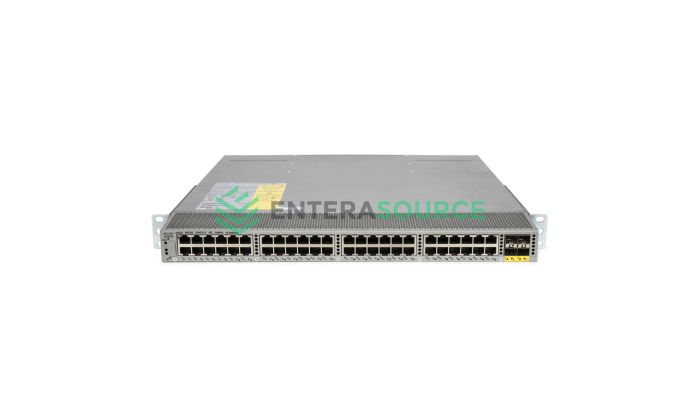
The Cisco Nexus 2248TP-E is a 1RU Nexus fabric extender with 48 host ports running at 100 Megabit or 1 Gigabit over twisted pair and 4 SFP+ fabric ports running at 10 Gigabit. As with every fabric extender it behaves as a remote line card for a parent Nexus switch and has no standalone function, so the parent platform is part of the specification rather than an afterthought.
Host ports, fabric ports and the buffer that distinguishes this model
Buffering is what separates the E variant from the ordinary 2248TP. This model carries a 32 MB shared buffer, which is the reason it is specified for workloads that produce heavy incast, such as distributed storage and map-reduce style traffic where many hosts answer at once and their replies converge on a single egress path. The E designation exists for that buffer, not for a port-count difference.
| Specification | Nexus 2248TP-E |
|---|---|
| Rack height | 1RU |
| Host ports | 48 x 100/1000BASE-T |
| Fabric ports | 4 x SFP+, 10 Gbps |
| Shared buffer | 32 MB |
| NEBS | Level 3, hardware revision 3 |
It needs a parent switch, and the supported list is model-specific
Fabric extenders do not forward traffic independently. Configuration, policy and control all live on the parent Nexus switch, and the extender's fabric ports exist solely to reach it. A 2248TP-E without a compatible parent is inert hardware.
Supported parent platforms and the minimum software release differ between fabric extender generations, and they are confirmed against your specific parent switch before the order rather than published here, because the list for this model must not be inherited from a different extender in the same family. Send the parent model and its running NX-OS release with the enquiry and the compatibility is checked directly.
Airflow: the fan suffix means the opposite of what most people expect
Fan modules for this extender carry an airflow convention that has caught out enough buyers to be worth stating explicitly. Cisco lists N2K-C2248-FAN as standard airflow, port-side exhaust, and N2K-C2248-FAN-B as back-to-front, meaning port-side intake. Confirm the direction against the aisle layout of the rack rather than against the suffix letter, and make sure every fan fitted to a single unit blows the same way.
What the deep buffer is actually for
Incast is the traffic pattern this model was built to survive. It occurs whenever many hosts reply to one request simultaneously and their responses converge on a single egress port in the same instant, which is the normal behaviour of distributed storage, clustered databases and analytics frameworks. A shallow buffer discards the overflow and the application sees retransmissions and stalled requests rather than a congestion counter.
A 32 MB shared buffer holds that burst long enough for the egress port to drain it. That is why the E variant carries a price premium over the standard 2248TP despite an identical port layout, and it is the only technical reason to choose one over the other. Where the traffic is ordinary north-south client access, the extra buffer buys nothing and the standard model is the correct specification.
NEBS Level 3 and where that matters
Network Equipment Building System Level 3 compliance at hardware revision 3 is a telecommunications qualification covering shock, vibration, fire resistance, temperature and airborne contaminants. It exists because carrier central offices and industrial sites impose environmental conditions that an ordinary data centre does not, and equipment without the qualification is frequently excluded from those sites by procurement policy rather than by engineering judgement.
For a conventional data centre deployment the qualification changes nothing about how the extender performs. For a carrier, utility, transport or industrial deployment it is often the reason this model is on the approved list and a comparable device is not, which makes it worth checking against the site standard before an alternative is substituted on cost.
Where it sits against the other extender we carry
| Model | Host ports | Fabric ports | Buffer |
|---|---|---|---|
| Nexus 2248TP-E | 48 x 100/1000BASE-T | 4 x SFP+, 10G | 32 MB |
| Nexus 2348UPQ | 48 x unified SFP+, 1/10G | Up to 6 x QSFP+, 10/40G | 32 MB |
Choose this model where the hosts are Gigabit copper and the requirement is buffer depth. Choose the Nexus 2348UPQ where the hosts are 10 Gigabit fibre or where unified ports are needed. Both sit in the Cisco networking hardware range, and the wider switch catalogue is under Cisco switches.
Condition, testing and what ships
Units are refurbished enterprise hardware carrying the original Cisco part number, tested on receipt and tested again on the bench after assembly and configuration, immediately before despatch. Each unit carries the Enterasource warranty stated on its listing, and shipping is free FedEx Ground to the lower 48 states. Fabric transceivers and cables are quoted separately and must match the parent switch port they land on. Cisco software entitlement does not transfer with used hardware, and any parent-switch licensing needed for extender support is held separately by the buyer rather than supplied with the unit.
Frequently Asked Questions
Can a Nexus 2248TP-E work without a parent switch?
No. A fabric extender operates as a remote line card for a parent Nexus switch, holding no independent configuration or forwarding function of its own. The fabric ports exist only to connect upstream. Buying one as a standalone 48-port Gigabit switch results in hardware that will not pass traffic, which is the most common misunderstanding about this product class.
What does the E mean in Nexus 2248TP-E?
It denotes the enhanced buffer version, carrying a 32 MB shared buffer. That capacity is aimed at incast-heavy traffic patterns where many hosts respond simultaneously and their replies converge on one path, which is common in distributed storage and analytics clusters. Host port count and media are otherwise as the standard model: 48 ports at 100 Megabit or 1 Gigabit.
Which fan module gives port-side exhaust on this extender?
Cisco lists N2K-C2248-FAN as the standard airflow module, described as port-side exhaust, and N2K-C2248-FAN-B as the back-to-front module, described as port-side intake. Verify the direction from Cisco's description of the specific part number rather than from the suffix, and ensure every fan module fitted to one unit shares the same direction.
Is the Nexus 2248TP-E the same as the standard 2248TP?
Not for the purpose it is usually bought for. The port layout is the same at 48 host ports and 4 fabric ports, but the E variant carries the 32 MB shared buffer that the standard model does not. Where the workload produces incast, that buffer is the entire difference between the two and substituting the standard model on price removes the reason the E was specified.
What speeds do the host ports on a Nexus 2248TP-E run at?
One hundred Megabit or 1 Gigabit, over twisted-pair copper, across all 48 host ports. Ten Gigabit host connectivity requires a different extender in the range, and the fabric side is separate: 4 SFP+ ports running at 10 Gigabit carry traffic back to the parent switch. Those fabric ports are not host ports and cannot be used to connect servers.
Which parent switches support the Nexus 2248TP-E?
Supported parent platforms and minimum software releases are model-specific across the fabric extender range and are confirmed against your parent switch before the order rather than listed here. Send the parent chassis model and the NX-OS release it is running, and compatibility is verified against Cisco documentation for this extender specifically rather than inferred from another model in the family.