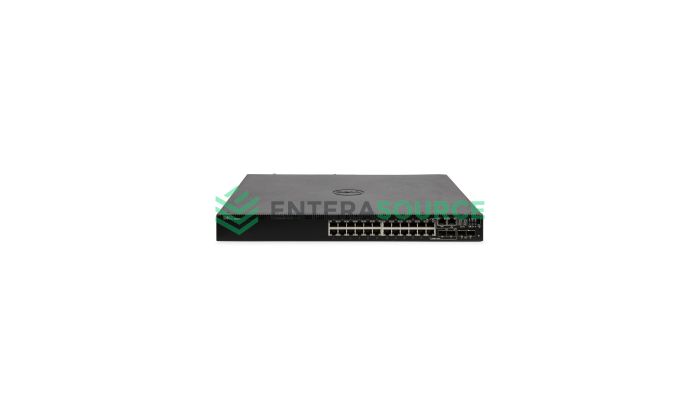
The Dell Networking S3124P is a 1RU managed campus access switch with 24 auto-sensing 10/100/1000Mb RJ45 ports delivering IEEE 802.3at PoE+ at up to 30.8W per port, two dedicated 10Gb SFP+ uplinks, two GbE combo media ports and a hot-swap expansion bay, running Dell Networking OS9.
Where it belongs in a network
The S3124P exists to power devices, not just to connect them. Twenty-four ports of IEEE 802.3at PoE+ at up to 30.8W each covers 802.11ac and 802.11ax access points, VoIP handsets, IP cameras with heaters and pan-tilt-zoom motors, door controllers, digital signage and video-conference endpoints - the entire class of device that would otherwise need a local power injector and a local outlet.
Twenty-four ports is the right density for one floor of a building, a single-storey branch, or a camera and access-control run around a warehouse perimeter. The switch is a full Layer 3 router in the same chassis, so a small site can terminate its own VLANs, run its own OSPF or BGP adjacency to the core, and isolate tenants or security zones with VRF-lite rather than trombone every packet to a distribution switch upstairs.
Twenty-four gigabit access ports against twenty gigabits of dedicated 10Gb SFP+ uplink is a 1.2:1 oversubscription ratio. Adding the two-port 10GbE expansion module doubles the uplink to 40Gb.
PoE+ power planning
The specification sheet is precise about two numbers and deliberately silent about a third, so it is worth being clear. Each port delivers up to 30.8W under IEEE 802.3at. The switch ships with a single 715W hot-swappable power supply, and Dell offers an 1100W supply specifically as the S3124P PoE+ headroom upgrade as well as for redundancy. Maximum system power consumption is 1,287W and maximum thermal output is 4,391.42 BTU/hr - both figures are the whole switch under full PoE+ load, not the PoE budget alone.
What that means practically: a single 715W supply does not cover twenty-four ports all drawing 30.8W simultaneously. Real deployments rarely need it to - an 802.11ax access point draws far less than 30.8W and a VoIP handset less again - but if you are planning around worst case, or you want the switch to survive a supply failure without shedding powered devices, specify two supplies and use the 1100W part. Dell does not publish a single system PoE budget figure for this model, so we do not quote one; size from the per-port draw of your actual devices against installed supply wattage.
Note also the thermal step. The non-PoE S3124 draws 52.8W and emits 182.55 BTU/hr. Fully loaded, the S3124P is roughly twenty-four times that heat load. A closet that comfortably held a non-PoE switch may not hold this one without airflow work.
Stacking and the expansion bay
Two dedicated stacking ports sit on the rear of the chassis, each rated at 21Gbps, giving 84Gbps of full-duplex stacking bandwidth. Up to twelve switches join a single stack, managed under one IP address, for a maximum of 624 ports presented as one logical device. Stacking cables are available in 0.25m, 1m and 3m, which is enough to reach across a rack or between two adjacent racks but not across a room - plan stack members physically together.
Because the stacking ports are separate from the front-panel SFP+ ports, stacking costs you no uplink capacity. That is a real architectural difference from switches that stack over their uplinks, and it is the reason the family scales cleanly: a twelve-unit stack still has twenty-four dedicated 10Gb SFP+ uplinks available to the core.
The single hot-swap expansion bay accepts either a two-port 10GBASE-T RJ45 module or a two-port 10GbE SFP+ module. Choose 10GBASE-T when the uplink is short structured copper and you want to avoid optics entirely; choose SFP+ when the uplink is fiber, when you need a DAC to a top-of-rack switch, or when you want the lower per-port power draw of a passive twinax run.
Operating system and management
Every S3100 ships with Dell Networking OS9 - the same image and the same command language used across the Dell S-series and N-series of the period, so a team already running OS9 elsewhere does not learn a second CLI. Management is by CLI over console, Telnet or SSHv2, by SNMP v1/v2c/v3 including Dell OpenManage Network Manager, and by a dedicated out-of-band 10/100/1000BASE-T management port that is entirely separate from the data plane. A USB Type-A port on the front takes configuration from a flash drive, and the switch carries dual firmware images on-board so an upgrade can be rolled back without a console session.
The feature set is genuinely enterprise-grade rather than a cut-down campus stack. Layer 3 includes OSPFv2 and OSPFv3, BGP-4 with IPv6 multiprotocol extensions, IS-IS, RIP, VRRP, PIM-SM and IGMPv1/v2/v3, with 16K IPv4 and 8K IPv6 routes and 511 VRF-lite instances for tenant or zone isolation. VLT provides active-active dual-homing without spanning-tree blocking. Interoperability with Cisco PVST+ is built in, which matters when the switch is going into a mixed-vendor campus. Security covers 802.1X with RADIUS, MAC Authentication Bypass, tiered authentication so one port can accept several methods in priority order, TACACS+ accounting and FIPS 140-2 approved cryptography. sFlow v5 and Routed Port Monitoring give you visibility across a Layer 3 domain without dedicated taps, and OpenFlow 1.3 is available for SDN deployments.
Where this model sits in the S3100 series
All five S3100 switches share the same 1RU chassis, the same Dell Networking OS9 image, the same stacking architecture and the same expansion bay. They differ in three things only: port count, port media, and whether the copper ports deliver PoE+.
- Dell Networking S3124
- Dell Networking S3124F
- S3124P (this page)
- Dell Networking S3148
- Dell Networking S3148P
If you need the same 1GbE density with an open network operating system rather than OS9, look at the Dell Networking S3048-ON, which uses ONIE to install an alternate NOS and offers a choice of airflow direction.
Condition, testing and support
Every unit is professionally refurbished: inspected, cleaned, configuration-wiped, firmware-checked and functionally tested on every port before it ships, and it ships with warranty. Refurbished S3100-series hardware is the sensible way to buy this generation - the platform is mature, the OS9 feature set is stable and fully documented, and the secondary market is where the supply now is.
Power supplies, expansion modules, stacking cables, rail kits and optics are configurable above. If you need a specific optic mix, a particular PoE supply configuration or a quantity for a multi-closet rollout, request a quote and we will build it to your bill of materials.
Chassis and Physical
| Chassis | 1RU, ReadyRails tool-less rack mounting |
|---|---|
| Dimensions (H x W x D) | 1.7126 in x 17.0866 in x 16.0236 in (43.5 mm x 434.0 mm x 407.0 mm) |
| Weight | 14.6 lbs (6.6 kg) |
| Management ports | Out-of-band management port (10/100/1000BASE-T); RJ45 console/management port with RS232 signaling (RJ-45 to female DB-9 cable included); USB Type A port for configuration via flash drive |
| Switching engine | Store and forward |
| Firmware | Dual firmware images on-board |
| Cooling | Redundant variable-speed fans; airflow I/O to power supply |
Switching and Routing Performance
| Switch fabric capacity | 212Gbps (full duplex) |
|---|---|
| Forwarding rate | 158Mpps |
| Line-rate switching | Layer 2 and Layer 3, all protocols, non-blocking |
| MAC addresses | 56K (80K in L2 scaled mode) |
| Static routes | 16K (IPv4) / 8K (IPv6) |
| Dynamic routes | 16K (IPv4) / 8K (IPv6) |
| IPv4 host table | 22K (42K in L3 scaled hosts mode) |
| IPv6 host table | 16K global + link local (32K in L3 scaled hosts mode) |
| IPv4 multicast table | 8K |
| Layer 2 VLANs | 4K |
| MSTP instances | 64 |
| VRF-lite instances | 511 |
| Link aggregation | 16 links per group, 128 groups |
| LAG load balancing | Based on Layer 2, IPv4 or IPv6 headers |
| Priority queues per port | 8 |
| MTU | 12,000 bytes |
| Packet buffer memory | 4MB |
| CPU memory | 2GB DDR3 |
| Flash memory | 1G |
Stacking and Expansion
| Stacking ports | 2 rear stacking ports at 21Gbps each, up to 84Gbps full-duplex |
|---|---|
| Stack scale | Up to 12 switches / 624 ports managed from a single IP address |
| Expansion bay | 1x hot-swap module bay: 2-port 10GBASE-T RJ-45 or 2-port 10GbE SFP+ uplink module |
| Stacking cable options | 0.25m, 1m and 3m |
| Direct attach cable options | SFP+ to SFP+ 10GbE copper twinax at 0.5m, 1m, 3m, 5m and 7m |
| Optics supported | SFP 100BASE-FX / 1000BASE-T / 1000BASE-SX / 1000BASE-LX / 1000BASE-ZX; SFP+ 10GbE SR / LR / LRM / ER |
Power and Thermal
| Power supply configuration | 1x 715W AC hot-swappable included; 1100W AC available as the PoE+ headroom upgrade or for redundancy |
|---|---|
| Power supply efficiency | 80% or better in all operating modes |
| Max power consumption | 1,287W |
| Max thermal output | 4,391.42 BTU/hr |
| PoE standard | IEEE 802.3af PoE and 802.3at PoE+ |
| PoE per port | Up to 30.8W |
Environmental
| Operating temperature | 32 to 113 F (0 to 45 C), Dell Fresh Air compliant |
|---|---|
| Operating relative humidity | 95% |
| Storage temperature | -40 to 149 F (-40 to 65 C) |
| Storage relative humidity | 85% |
Software, Protocols and Compliance
| Operating system | Dell Networking OS9 |
|---|---|
| Routing protocols | OSPFv2/v3, BGP-4 with IPv6 extensions, IS-IS, RIPv1/v2, VRRP, PIM-SM, IGMPv1/v2/v3, MSDP, policy-based routing |
| IEEE compliance | 802.1AB, 802.1D, 802.1p, 802.1Q, 802.1Qbb, 802.1Qaz, 802.1s, 802.1w, 802.1x, 802.1x-2010, 802.3ab, 802.3ac, 802.3ad, 802.1ax, 802.3ae, 802.3az, 802.3u, 802.3x, 802.3z, ANSI/TIA-1057 LLDP-MED, Force10 PVST+ |
| Security and AAA | 802.1X with RADIUS, MAC Authentication Bypass, authentication tiering, TACACS+ accounting, SSHv2, IPSec, FIPS 140-2 approved cryptography |
| Monitoring | sFlow v5, RMON / RMONv2, Routed Port Monitoring (RPM), port mirroring, SNMP v1/v2c/v3 |
| SDN | OpenFlow 1.3 |
| Certifications | TAA available, USGv6 Host and Router certified on Dell Networking OS 9.7 and greater, IPv6 Ready (Host and Router), DoD UC-APL approved, EU RoHS compliant |