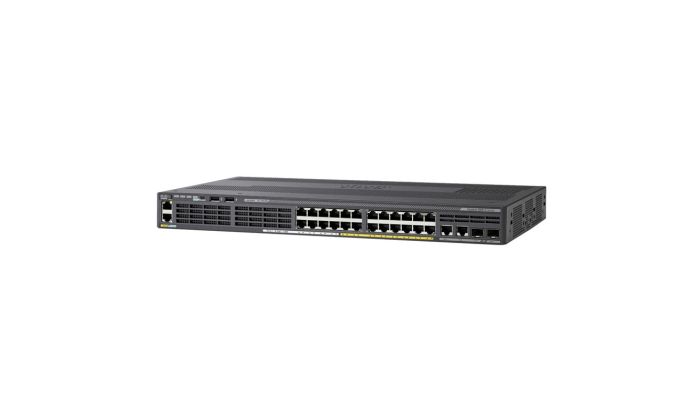
Only 8 of the 24 access ports on the Cisco Catalyst 2960X-24PSQ-L supply Power over Ethernet, and the shared budget for those 8 ports is 110 W. The other 16 are Gigabit data ports, the uplinks are 2 SFP slots plus 2 copper 10/100/1000 ports, and the software image is LAN Base rather than Lite, importantly, this model does not stack at all, which sets it apart from every other 2960-X.
Eight powered ports, not twenty-four
Cisco's own specification cell for this model reads "24 (8 PoE)". Twenty-four Gigabit access ports are present on the front panel and eight of them can source power. The remaining sixteen are data-only and will not power anything plugged into them, whatever the device requests. Any description of this switch as a 24-port PoE switch is materially wrong, and it is the single most important thing to establish before it is ordered.
The budget for those eight ports is 110 W, shared. Divided by the 30 W ceiling of an IEEE 802.3at PoE+ endpoint that supports 3 ports at full draw. Divided by the 15.4 W ceiling of an 802.3af endpoint it supports 7. So the practical powered-device count on this switch is between three and seven, not eight, and certainly not twenty-four.
| Specification | Catalyst 2960X-24PSQ-L |
|---|---|
| Access ports | 24 x 10/100/1000 Ethernet |
| Ports capable of PoE | 8 of 24 |
| PoE budget | 110 W combined |
| Ports at the 30 W PoE+ ceiling | 3 |
| Ports at the 15.4 W PoE ceiling | 7 |
| Uplinks | 2 x SFP plus 2 x 10/100/1000 copper |
| Software image | LAN Base |
| Forwarding rate | 71.4 Mpps |
| Forwarding bandwidth | 108 Gbps |
| Active VLANs | 1023 |
| Stacking | Not supported |
Four uplinks, two of them copper
The uplink arrangement here is also unlike the rest of the sub-series. Instead of 4 SFP slots or 2 SFP+ slots, this model carries 2 SFP slots and 2 copper 10/100/1000 ports. That gives a site the option of reaching its distribution layer over structured copper without a transceiver at all, which is genuinely useful in a small building where no fibre was ever pulled.
It also means the maximum uplink speed on this switch is 1 Gbps on any port. There is no 10 Gigabit option and no SFP+ slot to add one later, so a closet behind this model is committed to a Gigabit uplink for the life of the chassis.
It does not stack, and that is not a configuration problem
Every other LAN Base member of the 2960-X sub-series supports FlexStack-Plus at 80 Gbps across eight members. This one does not stack at all. There is no module, cable, licence or software release that adds the capability, and it will not join a stack of 2960-X, 2960-S or 2960-SF switches in any configuration. A design that plans to stack a closet of 2960-X switches has to exclude this part number explicitly.
Where the 24PSQ-L sits, and what to buy instead
This switch is a specific answer to a specific requirement: twenty-four Gigabit ports where only a handful of devices need power, in a room that has copper to the distribution layer and no need for stacking. Read against its nearest siblings the differences are stark rather than incremental.
| Model | PoE ports | PoE budget | Uplinks | Stacking |
|---|---|---|---|---|
| 2960X-24PSQ-L | 8 of 24 | 110 W | 2 x SFP + 2 copper | No |
| 2960X-24PS-L | 24 of 24 | 370 W | 4 x SFP, 1 Gbps | FlexStack-Plus |
| 2960X-24TS-LL | None | None | 2 x SFP, 1 Gbps | No |
If more than seven devices need power, the 24PS-L is the correct model and this one is not. If a full 48-port powered closet is the requirement, the Catalyst 2960X-48FPS-L covers it. The current-generation replacement line is the Catalyst 9300 family, and a small site's routing is typically a Cisco ISR 4321.
Support position: this model is excluded from the family notice
Cisco's end-of-life notice EOL13603 covers the Catalyst 2960-X product family, and this model is not named in it. It is announced separately under its own notice, so the family dates that apply to the rest of the sub-series do not apply here and should not be assumed to. Anyone planning a support position around this switch needs to read its own announcement rather than the family one.
That exclusion is stated here rather than glossed over because the consequence is practical. A procurement team that reads the family notice, sees a hardware support date and assumes it covers every part number in the sub-series will be planning against the wrong document for this one switch.
Condition, testing and what ships
Refurbished enterprise hardware carrying the original Cisco part number. Each unit is tested on receipt, then disassembled, cleaned, inventoried and returned to stock; on order it is rebuilt, configured and bench tested again before packing, with the eight powered ports exercised as part of that outbound test. Whole systems including this switch carry the 2-year Enterasource warranty and ship free by FedEx Ground to the lower 48 states.
SFP transceivers are separate line items. Cisco software entitlement is not included and does not transfer with used hardware.
Frequently Asked Questions
How many ports on a Catalyst 2960X-24PSQ-L actually supply PoE?
Eight of the twenty-four. Cisco's specification cell for this model reads "24 (8 PoE)", meaning twenty-four Gigabit access ports of which eight can source power and sixteen cannot. Nothing in configuration changes that split; it is a property of the hardware. Describing this switch as a twenty-four-port PoE model is simply incorrect.
What can 110 W of PoE run on a 2960X-24PSQ-L?
Three endpoints at the 30 W ceiling of an IEEE 802.3at PoE+ device, or seven at the 15.4 W ceiling of the older 802.3af class, from a shared 110 W pool across the eight capable ports. Even at the lowest class the budget runs out before the eighth port is filled, so this is a switch for a small number of telephones or a couple of cameras.
Can a 2960X-24PSQ-L be stacked with other Catalyst 2960-X switches?
No. Unlike the rest of the LAN Base 2960-X sub-series, this model does not support FlexStack-Plus and does not stack in any combination. No module, cable or software release adds the capability. If stacked management across a closet is a requirement, this part number has to be excluded from the design and a stacking-capable model specified in its place.
What uplinks does the 2960X-24PSQ-L have?
Two SFP slots and two copper 10/100/1000 ports, which is a different arrangement from every other model in the sub-series. The copper uplinks allow a distribution connection over structured cabling with no transceiver at all. The ceiling on any uplink here is 1 Gbps, because there is no SFP+ slot and none can be added later.
Is the Catalyst 2960X-24PSQ-L covered by Cisco notice EOL13603?
It is not. EOL13603 covers the Catalyst 2960-X product family and this model is not named in it; Cisco announced it separately under its own notice. The dates published for the rest of the sub-series therefore do not describe this switch, and a support plan built on the family notice will be built on the wrong document for this part number.
What checks does a refurbished 2960X-24PSQ-L receive?
It is bench tested on arrival, then cleaned, inventoried and held as known-good stock before being rebuilt and configured to the order. The outbound test exercises all twenty-four access ports, both copper uplinks, both SFP slots and the eight powered ports specifically. Condition is graded per chassis and any fault is published on that unit's listing. The full range is on the Cisco networking hardware page.