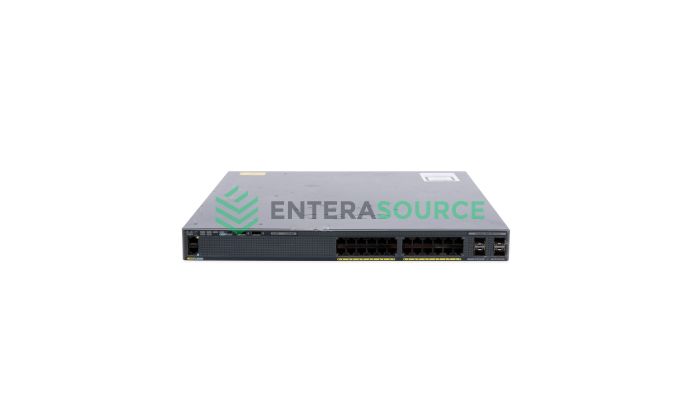
The Cisco Catalyst 2960XR-24TS-I offers 24 Gigabit data ports, 4 SFP uplink slots at 1 Gbps and the IP Lite image, with no Power over Ethernet available anywhere on the front panel. What it does carry is the 2960-XR power architecture: two internal field-replaceable power supply bays, conventionally shipped with one bay populated and the second left for the buyer to fill.
IP Lite is the image every 2960-XR carries
The trailing I in this model designation marks the IP Lite software image, and Cisco lists it on all ten members of the Catalyst 2960-XR sub-series. That is a structural fact rather than a configuration option: there is no LAN Base version of an XR chassis and no licence that moves an XR down to the image used across the 2960-X family. Choosing an XR part number is choosing IP Lite.
It is worth being clear about what that means when comparing an XR against an X on a price list. The two switches are not the same hardware at different prices. They differ in the software tier and in the power architecture, and both differences are fixed by the part number. A site that needs neither is better served by the 2960-X equivalent; a site that needs either is choosing correctly.
| Specification | Catalyst 2960XR-24TS-I |
|---|---|
| Access ports | 24 x 10/100/1000 Ethernet |
| Power over Ethernet | None |
| Uplinks | 4 x SFP, 1 Gbps |
| Aggregate uplink capacity | 4 Gbps |
| Software image | IP Lite |
| Second-supply rating | 250 W |
| Power supply bays | 2, field-replaceable, one populated by default |
| Stacking | FlexStack-Plus, 80 Gbps, 8 members |
Four uplinks and two supplies: a resilience specification
This particular combination is the most conservative one the sub-series offers. Four SFP slots at 1 Gbps allow two links into each of two distribution switches, and two power supply bays allow the chassis to survive losing one module. Between them they eliminate the two failures that most often take a wiring closet offline, and neither requires an external chassis or additional rack units.
The cost is uplink capacity. Four Gigabit slots deliver 4 Gbps in aggregate against the 20 Gbps two SFP+ slots would provide on the D variant. For twenty-four data ports that is rarely the binding constraint, and where it is, the D model trades two of the four paths for the extra capacity.
What a data-only XR is actually for
Rooms that justify dual internal supplies and no Power over Ethernet are a recognisable class: server rooms, control rooms, small aggregation points, clinical and industrial spaces, and any closet where the powered devices are handled elsewhere but the switch itself must not stop. The absence of a PoE stage also reduces heat and removes a subsystem, which suits exactly those environments.
Stacking, and the boundary that catches people
FlexStack-Plus gives this switch 80 Gbps of stack throughput across up to eight members on the IP Lite image, managed as a single logical device. A Catalyst 2960-XR stacks only with other Catalyst 2960-XR switches; it will not stack with a 2960-X, a 2960-S or a 2960-SF in either direction. Stacking modules and cables are separate parts from the chassis and should be quoted with a stack build rather than assumed.
Where the 24TS-I sits in the 2960-XR range
Comparing this model against the 48-port data switch and the 24-port SFP+ switch shows the two axes the sub-series varies on: port count and uplink media.
| Model | Access ports | Uplinks | PoE | Image |
|---|---|---|---|---|
| 2960XR-24TS-I | 24 Gigabit | 4 x SFP, 1 Gbps | None | IP Lite |
| 2960XR-48TS-I | 48 Gigabit | 4 x SFP, 1 Gbps | None | IP Lite |
| 2960XR-24TD-I | 24 Gigabit | 2 x SFP+, 10 Gbps | None | IP Lite |
Where powered ports are needed at 48-port scale on the LAN Base image, the Catalyst 2960X-48FPS-L is the model built for it. For a current-generation platform the Catalyst 9300 family is the line to compare, and a small site's routing typically sits on a Cisco ISR 4321.
Lifecycle and support horizon
Cisco announced this model with the rest of the Catalyst 2960-XR family in end-of-life notice EOL13602. End-of-Sale for the hardware was 31 October 2022, the Last Ship Date was 30 January 2023 and End of Software Maintenance was 31 October 2023. The Last Date of Support and End of Vulnerability and Security Support both fall on 31 October 2027, with End of Service Contract Renewal on 29 January 2027.
Those dates are identical to the Catalyst 2960-X family's notice, so there is no support-horizon reason to choose an XR. The reasons are the IP Lite image and the internal supply bays, and on a data-only chassis the second of those is the one that usually decides it.
Condition, testing and what ships
Units are refurbished enterprise hardware carrying the original Cisco part number. Each is bench tested on receipt, then disassembled, cleaned, inventoried and returned to stock; on order it is reassembled to the requested specification, configured and tested again immediately before packing. Whole systems including this switch carry the 2-year Enterasource warranty, with free FedEx Ground delivery to the lower 48 states.
The number of power supplies fitted is specified at order rather than assumed. SFP transceivers, stacking modules and cables are separate line items, and Cisco software entitlement does not transfer with used hardware.
Frequently Asked Questions
Do all Catalyst 2960-XR switches run IP Lite?
Yes. Cisco lists IP Lite as the software feature set on all ten members of the Catalyst 2960-XR sub-series, and the trailing I in each model designation marks it. There is no LAN Base variant of an XR chassis and no licence that changes the image, so specifying an XR part number is specifying IP Lite along with the dual-bay power architecture.
Why buy a 2960XR-24TS-I instead of the equivalent 2960-X?
For the two internal power supply bays and the IP Lite image. The 2960-X is a LAN Base switch whose redundancy option is an external Redundant Power System 2300 occupying its own rack space. If neither the software tier nor the internal redundancy is required, the 2960-X equivalent is the more economical answer and there is no reason to pay for capability the room will not use.
How many uplink paths does a 2960XR-24TS-I provide?
Four, through 4 SFP slots at 1 Gbps, for 4 Gbps of aggregate capacity. The usual deployment is two links into each of two distribution switches so that the closet survives the loss of a fibre, a transceiver or an entire upstream device. The SFP+ variant of this switch trades two of those paths for up to 20 Gbps across the remaining two.
Can a Catalyst 2960-XR stack with a 2960-S or 2960-SF?
No. The XR forms its own stacking domain and joins only with other XR switches, running FlexStack-Plus at 80 Gbps across up to eight members. The backward compatibility that lets a 2960-X stack with a 2960-S does not extend to the XR in either direction, so a mixed order will produce separate stacks rather than one.
What state does a refurbished 2960XR-24TS-I arrive in?
Cleaned, tested and configured to the order, with the supply count recorded against that specific chassis. Both bench passes exercise every fitted supply and all four SFP slots, the first on receipt and the second immediately before packing. Cosmetic condition is graded per serial and any defect appears on that unit's listing. The full range is on the Cisco networking hardware page.