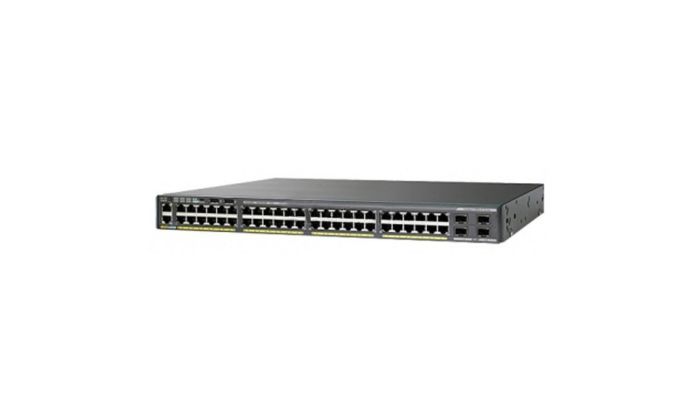
The Cisco Catalyst 2960XR-48FPS-I is the 48-port full-PoE member of the 2960-XR range fitted with Gigabit uplinks. It carries 48 PoE+ access ports, 4 SFP uplink slots at 1 Gbps, the IP Lite software image rather than LAN Base, and a 740 W Power over Ethernet budget that Cisco rates identically, regardless of whether one supply is fitted or both bays are populated.
Every port powered at the standard class
The useful way to read 740 W on a 48-port chassis is against the lower power class. Cisco publishes 48 ports at up to 15.4 W for this model, which is the whole front panel at the standard 802.3af ceiling, and 24 ports at up to 30 W for PoE+ endpoints. Both counts are the same in the single-supply build and with both bays populated, because the budget itself does not move.
What the second supply changes is what happens to a fully populated front panel when a module dies. Cisco's power-combination table gives the full 740 W of PoE+ as still available after one of a pair of supplies fails, so a floor of telephones with a few higher-draw devices among them keeps every port powered through the event rather than shedding the ports at the bottom of the priority list.
| Specification | Catalyst 2960XR-48FPS-I |
|---|---|
| Access ports | 48 x 10/100/1000 Ethernet |
| Uplinks | 4 x SFP, 1 Gbps |
| Software image | IP Lite |
| Available PoE, one or two supplies | 740 W |
| Ports at up to 30 W PoE+ | 24 |
| Ports at up to 15.4 W PoE | 48 |
| PoE retained if one supply fails | 740 W |
| Power supply | PWR-C2-1025WAC only, 2 bays, one populated by default |
| Stacking | FlexStack-Plus, 80 Gbps, 8 members |
Four Gigabit uplinks on the highest-power chassis in the family
This is the model for a closet that needs maximum powered capacity and diverse paths rather than maximum uplink bandwidth. The 4 SFP slots at 1 Gbps support two links into each of two distribution switches, so neither a failed supply nor a failed upstream device takes the room offline. Against the SFP+ variant of the same switch the trade is 4 Gbps across four paths in place of up to 20 Gbps across two.
Which of those is correct depends entirely on what is plugged in. Telephones, door controllers, cameras and clocks consume watts without generating much upstream traffic, and a closet full of them is far better served by four resilient Gigabit paths. Dense wireless is the case that reverses it.
What the second supply protects
Cisco supports dual redundant power supplies on the Catalyst 2960-XR Series and ships these switches with one supply by default, with the second available at the time of order or later as a spare. Fitting it does not enlarge the 740 W budget; it protects it, keeping the whole figure available through the loss of either module. On this model the second supply must be a PWR-C2-1025WAC, because Cisco's installation guide bars the 250 W and 640 W modules from the two full-PoE XR switches.
The IP Lite image
All ten Catalyst 2960-XR models carry the IP Lite feature set, marked by the trailing I in the designation. It is the software tier above the LAN Base image used across the 2960-X family and it is fixed by the part number. An XR cannot be ordered with LAN Base and cannot be moved to it afterwards, so the image is part of what is being bought.
Where the 48FPS-I sits in the 2960-XR range
Reading this model against the reduced-power switch with the same uplinks and against the SFP+ variant of itself isolates the two decisions: how many watts, and which uplink media.
| Model | PoE budget | PoE retained if a supply fails | Uplinks |
|---|---|---|---|
| 2960XR-48FPS-I | 740 W | 740 W | 4 x SFP, 1 Gbps |
| 2960XR-48LPS-I | 370 W | 370 W | 4 x SFP, 1 Gbps |
| 2960XR-48FPD-I | 740 W | 740 W | 2 x SFP+, 10 Gbps |
Where internal redundancy is not required and 740 W is enough, the Catalyst 2960X-48FPS-L is the LAN Base equivalent with an identical front panel. The current-generation counterpart is a Catalyst 9300 48-port model, and the wider current-generation line is the Catalyst 9300 family.
Lifecycle and support horizon
Cisco covered this model in end-of-life notice EOL13602 for the Catalyst 2960-XR product family. End-of-Sale for the hardware was 31 October 2022, the Last Ship Date was 30 January 2023 and End of Software Maintenance was 31 October 2023. Both the Last Date of Support and End of Vulnerability and Security Support fall on 31 October 2027, with End of Service Contract Renewal on 29 January 2027.
Because those dates match the Catalyst 2960-X notice exactly, the horizon is not a reason to prefer this sub-series. What is a reason is that no 2960-X carries a second supply inside the chassis, so no 2960-X holds its full PoE budget through a supply failure without an external system in the rack, and that stays true for the whole remaining support window.
Condition, testing and what ships
Refurbished enterprise hardware bearing the original Cisco part number. Each unit is tested on receipt, then disassembled, cleaned, inventoried and returned to stock; on order it is rebuilt to specification, configured and bench tested again before packing, with the power stage and every fitted supply exercised. Whole systems including this switch carry the 2-year Enterasource warranty and ship free by FedEx Ground to the lower 48 states.
Supply count is specified at order rather than assumed. SFP transceivers, stacking modules and cables are separate line items, and Cisco software entitlement does not transfer with used hardware.
Frequently Asked Questions
Can a Catalyst 2960XR-48FPS-I power all 48 ports at standard PoE?
Yes, with either supply configuration. Cisco publishes 48 ports at up to 15.4 W for this model against its 740 W budget, so the whole front panel is coverable at the standard 802.3af class in the default single-supply build. Fitting the second supply does not raise the count, because the budget is identical with one supply or two; it keeps all 48 ports powered when one of the two modules fails.
Should I choose the FPS or the FPD version of the 48-port 2960-XR?
It depends on what the powered devices do upstream. The FPS carries 4 SFP slots at 1 Gbps for four diverse paths; the FPD carries 2 SFP+ slots for up to 20 Gbps across two. Telephones, cameras and controllers consume watts without much traffic and suit the FPS. A dense wireless deployment generates traffic in proportion to the watts and suits the FPD.
What happens to PoE on a 2960XR-48FPS-I if one power supply fails?
With both bays populated, nothing. Cisco's power-combination table lists the available PoE+ after a single supply failure as the full 740 W, which is the same figure the switch carries in normal operation, so no port is shed and no endpoint renegotiates its class. With only one supply fitted the failure takes the switch and every powered device behind it, which is the exposure the second module exists to remove.
Which software image does a Catalyst 2960XR-48FPS-I run?
IP Lite, marked by the trailing I in the model designation, and it is the image on all ten members of the Catalyst 2960-XR sub-series. There is no LAN Base version of an XR chassis, and the image cannot be changed by any licensing action, so the software tier is decided by the part number at the point of purchase.
What testing does a refurbished 2960XR-48FPS-I receive?
Two bench passes, one on arrival and one after the chassis has been rebuilt and configured to the order. Both exercise every fitted power supply individually, and the outbound pass covers all forty-eight powered ports and all four SFP slots immediately before packing. Condition is graded against that serial and disclosed on the listing. The wider range is on the Cisco networking hardware page.