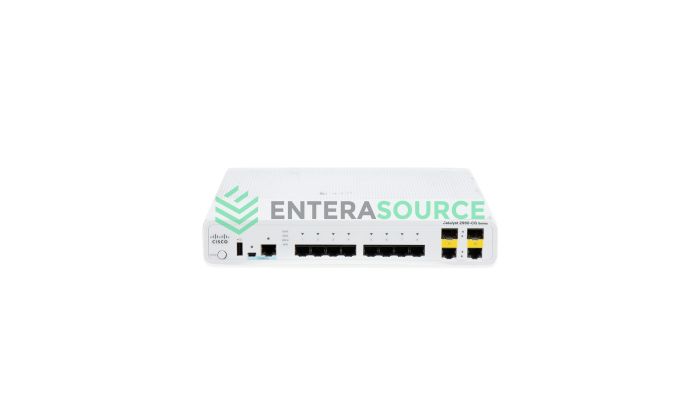
Gigabit access ports are what the CG in the Cisco Catalyst 2960CG-8TC-L denotes: 8 of them in total, against the 10/100 ports carried by every other model in the compact 2960-C line. Beyond that one difference in port speed the switch matches its Fast Ethernet sibling almost exactly, specifically 2 dual-purpose uplinks, the LAN Base image, an internal supply and no PoE.
CG means Gigabit, and it is the only compact model that does
Cisco's product description for this part number reads "2960C Switch 8 GE, 2 x Dual Purpose Uplink, LAN Base", where GE is Gigabit Ethernet. The equivalent Fast Ethernet model in the same family reads "8 FE" instead. That single letter pair in the model designation is the entire functional difference between the two, and it is the reason to pay attention to it on a purchase order.
The practical significance depends entirely on what is being connected. For telephones, card readers and terminals, 100 Mbps was never a constraint and the Fast Ethernet model is the more economical choice. For a meeting room with a video codec, a wireless access point, a laptop dock or a device that moves files, a Gigabit port is the difference between a link that keeps up and one that does not, and there is no way to upgrade a Fast Ethernet chassis later.
| Specification | Catalyst 2960CG-8TC-L |
|---|---|
| Part number | WS-C2960CG-8TC-L |
| Access ports | 8 x 10/100/1000 Gigabit Ethernet |
| Power over Ethernet | None |
| Uplinks | 2 dual-purpose, one port active per pair |
| Power supply | Internal, mains connected |
| Software image | LAN Base |
| Height | 1.75 in |
| Width | 10.6 in |
| Depth | 8.4 in |
Eight Gigabit ports in half a rack width
The chassis is 10.6 inches wide and 8.4 inches deep, a little over half the 17.5-inch width of a rack switch, so it goes where a rack does not: a table box, a wall cabinet, a shelf, a lectern. Putting eight Gigabit ports in that footprint is what makes the model useful for modern meeting rooms and teaching spaces, where the endpoints have moved past 100 Mbps but the room still has no rack.
It also means the uplink deserves attention. Eight Gigabit access ports behind a single active Gigabit uplink is an eight-to-one ratio, which is fine for typical room traffic and tight if several endpoints move large files at once. Where that is a real risk, the room usually wants a cable back to a comms-room switch rather than a larger compact one.
The Fast Ethernet version of this chassis has the opposite profile, at eight 100 Mbps ports behind the same Gigabit uplink, which is under one to one and never constrained. That contrast is a useful way to decide between the two: the CG model raises what each endpoint can do while leaving the exit from the room unchanged, so it suits rooms with a few demanding devices rather than rooms with many modest ones.
An internal supply and a mains outlet
This model has its own power supply and connects to mains power, exactly as the Fast Ethernet version does. Locations with structured cabling but no socket are served instead by the CPD models in the same compact family, which draw power over an uplink. The distinction is fixed by the part number, so the installation point should be checked before the order rather than after delivery.
Dual-purpose uplinks
Two uplinks, each holding a copper Gigabit port and an SFP slot with one port active at a time, giving two usable paths from four connectors. Copper is the common choice in compact deployments because the switch is reached over structured cabling, while the SFP option covers outbuildings and satellite spaces served over fibre.
Where the CG-8TC-L sits in the compact 2960-C range
The comparison that matters is against its Fast Ethernet twin, because the two are otherwise the same switch and are easy to confuse on a stock list.
| Model | Access ports | Port speed | Depth | Power source |
|---|---|---|---|---|
| 2960CG-8TC-L | 8 | 10/100/1000 | 8.4 in | Internal supply |
| 2960C-8TC-L | 8 | 10/100 | 8.4 in | Internal supply |
| 2960C-12PC-L | 12 | 10/100 | 9.4 in | Internal supply |
Where a full closet of Gigabit ports with power is the requirement, the Catalyst 2960X-48FPS-L is the rack-width answer with a 740 W budget. The current-generation counterpart for managed access switching is a Catalyst 9300 24-port model, and the routing tier for a site of this kind is typically a Cisco ISR 4331.
Support position for the compact line
No lifecycle dates appear on this page. The Catalyst 2960-C compact line has no Cisco end-of-life notice in the verified source material behind these pages, and every date shown across the rest of our Catalyst 2960 range is anchored to a specific named announcement. The gap is left visible rather than estimated away.
Before committing to a support arrangement, check the exact part number in Cisco's own end-of-life listing. The rack-width 2960 sub-series each have their own notices covering their own hardware, and none of them describes the compact models.
Condition, testing and what ships
Units are refurbished enterprise hardware carrying the original Cisco part number. Each is tested on receipt, then disassembled, cleaned, inventoried and returned to stock; on order it is rebuilt, configured and bench tested a second time before packing, with all eight Gigabit ports and both uplink pairs verified. Whole systems including this switch carry the 2-year Enterasource warranty, and delivery is free FedEx Ground to the lower 48 states.
External case condition is graded per unit because these switches are usually installed in visible locations. Mounting hardware and SFP transceivers are separate line items, and Cisco software entitlement is not included with used hardware.
Frequently Asked Questions
What does CG mean on a Catalyst 2960CG-8TC-L?
Gigabit access ports. Cisco's product description for this part number reads "2960C Switch 8 GE, 2 x Dual Purpose Uplink, LAN Base", where GE is Gigabit Ethernet, while the equivalent Fast Ethernet model reads 8 FE. It is the only compact model in this family with Gigabit access ports, and the letter pair is the sole functional difference.
Should I choose the CG model over the Fast Ethernet compact switch?
It depends on the endpoints. Telephones, card readers and terminals never needed more than 100 Mbps, so the Fast Ethernet version is the more economical fit for those rooms. Video codecs, wireless access points, laptop docks and anything moving files benefit from a Gigabit port, and a Fast Ethernet chassis cannot be upgraded to provide one later.
How many Gigabit ports does a 2960CG-8TC-L have in total?
Eight access ports at 10/100/1000, plus two uplink paths that are also Gigabit-capable through either the copper port or the SFP slot in each dual-purpose pair. Only one port per uplink pair is active at a time, so the total usable Gigabit connections are eight access and two uplink.
Does the compact CG switch need mains power?
Yes. It has an internal power supply and must be plugged into a socket at the installation point, exactly like its Fast Ethernet twin. Rooms with structured cabling but no power outlet are served by the CPD models in the same compact family, which take power over an uplink cable from an upstream switch instead.
What is verified on a used Catalyst 2960CG-8TC-L?
All eight Gigabit access ports and both uplink pairs are exercised on the outbound bench pass, after the chassis has been rebuilt and configured to the order, with an earlier pass on receipt to confirm the hardware before it entered stock. External case condition is graded per serial because these units are usually visible in the room. The range is on the Cisco networking hardware page.