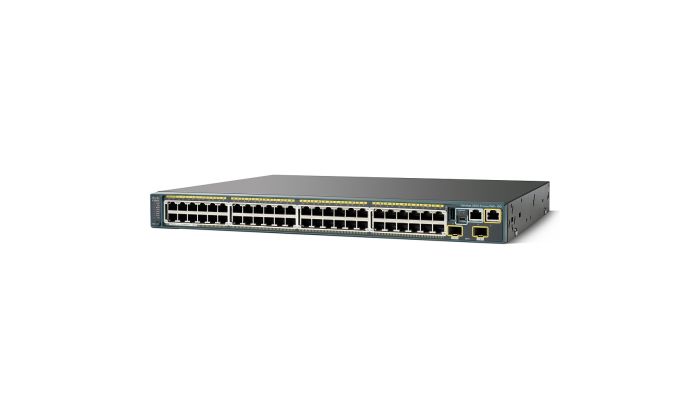
The Cisco Catalyst 2960S-48FPD-L pairs 48 PoE+ capable Gigabit access ports with 2 SFP+ uplink slots that run at 10 Gbps, in a 1U chassis running the LAN Base image. Those two 10G uplinks are the whole reason to pick this model over the 4 x 1G SFP version beside it, because the access layer, apart from the uplinks, is identical: 48 ports, 740 W of PoE, one rack unit.
Uplinks: the one thing that separates the FPD from the FPS
Uplink media is the only functional difference between the 48-port PoE models in the 2960-S sub-series, and the model designation carries it. A trailing D means 2 SFP+ slots that run at 10 Gbps. A trailing S means 4 SFP slots that run at 1 Gbps. Same 48 access ports, same 740 W PoE budget, same LAN Base image, same 1U chassis. The decision is therefore about the distribution layer this closet uplinks into, not about the closet itself.
Two 10G uplinks give 20 Gbps of aggregate uplink capacity against 4 Gbps from four 1G links, and they do it on two fibre pairs instead of four. Where a closet is fully populated with PoE endpoints pushing wireless traffic upstream, that is the difference between an uplink that shapes traffic and one that does not.
| Specification | Catalyst 2960S-48FPD-L |
|---|---|
| Access ports | 48 x 10/100/1000 Ethernet |
| PoE standard | IEEE 802.3af and 802.3at PoE+, up to 30 W per port |
| PoE budget | 740 W combined |
| Uplinks | 2 x SFP+, 1/10 Gbps |
| Software image | LAN Base |
| Forwarding rate | 101.2 mpps |
| Forwarding bandwidth | 88 Gbps |
| Switching bandwidth | 176 Gbps |
| Active VLANs | 255 |
| Flash / DRAM | 64 MB / 128 MB |
| Rack height | 1U, 1.75 x 17.5 x 15.2 in |
PoE budget and what 740 W actually covers
Seven hundred and forty watts is the shared pool available to all 48 access ports, allocated on demand rather than reserved per port. Dividing that pool by the 30 W maximum draw of an IEEE 802.3at PoE+ endpoint gives 24 ports at full PoE+ load. Dividing it by the 15.4 W maximum of an 802.3af endpoint gives all 48. A mixed closet lands in between, and the practical planning number is the sum of the actual class draws of the devices going in, not the port count on the front panel.
Stacking, and the module that is not in the box
Stacking on this switch is FlexStack at 20 Gbps of stack throughput, and it requires the optional FlexStack module. The module is a separate part, so a used 2960-S bought for a stack build needs it specified alongside the chassis. Once stacked, the members share one configuration and one management address. A 2960-X fitted with a FlexStack-Plus module will join a stack with this switch at a reduced 40 Gbps and a 4-member ceiling; a 2960-XR will not join at all.
Power redundancy on the 2960-S
Redundancy on this platform is external. The chassis holds one fixed internal supply and no second module bay, and Cisco covers the resilience case through the Redundant Power System 2300 rather than through a field-replaceable second unit inside the switch. For a closet with a genuine uptime requirement that is a rack-space and budget decision to make at design time, because retro-fitting an external redundant supply to a live closet means touching every switch it protects.
Where the 48FPD-L sits in the 2960-S range
Two comparisons decide most 2960-S purchases: whether the uplinks need to be 10G, and whether the access ports need to be Gigabit at all. The SF models that share this naming pattern are FastEthernet switches, and their model designations differ by a single leading F.
| Model | Access ports | PoE budget | Uplinks | Forwarding rate |
|---|---|---|---|---|
| 2960S-48FPD-L | 48 Gigabit | 740 W | 2 x SFP+, 10 Gbps | 101.2 mpps |
| 2960S-48FPS-L | 48 Gigabit | 740 W | 4 x SFP, 1 Gbps | 77.4 mpps |
| 2960SF-48FPS-L | 48 FastEthernet | 740 W | 4 x SFP, 1 Gbps | Not comparable |
The Catalyst 2960S-48FPS-L is the same switch with 1G uplinks. The Catalyst 2960X-48FPD-L is the generational successor with the same port and uplink layout, four times the stack bandwidth and a Cisco support horizon that has not yet closed. The full Cisco range is on the Cisco networking hardware page.
Lifecycle and support horizon
End-of-life notice EOL10043 covers the Catalyst 2960-S and 2960-SF families and names this model. End-of-Sale was 6 November 2015, the Last Ship Date was 4 February 2016, End of Vulnerability and Security Support was 5 November 2018 and the Last Date of Support was 30 November 2020. Cisco's stated migration path is the equivalent 2960-X model.
All of those milestones are behind us, which is the honest frame for this switch: it is bought as a like-for-like replacement or a stack member for an installed base, not as the platform for a new build with a ten-year horizon in front of it. That is a legitimate and common requirement, and it is why these units still move.
Condition, testing and what ships
Each unit is refurbished enterprise hardware carrying the original Cisco part number. Testing is inbound on receipt, then the switch is disassembled, cleaned, inventoried, picked, assembled, configured and tested again on the bench immediately before shipping. Whole systems including this switch carry the 2-year Enterasource warranty. Shipping is free FedEx Ground to the lower 48 states.
SFP+ transceivers, the FlexStack module and rack hardware are quoted separately unless specified with the switch. Cisco software entitlement does not transfer with used hardware.
Frequently Asked Questions
What is the difference between a 2960S-48FPD-L and a 2960S-48FPS-L?
The uplinks, and nothing else that affects a deployment. The FPD carries 2 SFP+ slots capable of 10 Gbps; the FPS carries 4 SFP slots capable of 1 Gbps. Access ports, PoE budget, software image and chassis height are identical across the two. Pick the FPD when the closet uplinks into a 10G distribution layer and the FPS when four separate 1G fibre paths suit the topology better.
Can the SFP+ ports on a 2960S-48FPD-L run at 1 Gbps?
Yes. The uplink slots on the D models are documented as 1G and 10G capable, so a 1G SFP transceiver is a valid fit and a closet can be commissioned on 1G optics and moved to 10G later without changing the switch. That flexibility is the practical argument for buying the D model even where the distribution layer is still Gigabit at the time of installation.
How much PoE does a Catalyst 2960S-48FPD-L supply?
A combined 740 W across all 48 access ports, shared rather than reserved. That covers 24 endpoints drawing the full 30 W permitted to an IEEE 802.3at PoE+ device, or all 48 endpoints at the 15.4 W ceiling of the older 802.3af class. Plan against the summed class draw of the devices being connected, because a floor of high-draw outdoor access points exhausts the budget well before the port count runs out.
Does the 2960S-48FPD-L come with a FlexStack module?
No. FlexStack is an optional module on the 2960-S and it is ordered separately from the chassis, so a switch bought on the secondary market should be assumed not to have one unless the listing says otherwise. With the module fitted the stack runs at 20 Gbps and the members share a single configuration and management address.
Is the Catalyst 2960-S covered by a current Cisco support contract?
It cannot be. Under notice EOL10043 the End of Service Contract Renewal date was 4 February 2020 and the Last Date of Support was 30 November 2020, so no new Cisco contract can be attached to this platform and no software fixes are issued for it. Hardware support for a deployed fleet therefore comes from spares holding and third-party coverage rather than from Cisco.
What testing does a refurbished Catalyst 2960-S go through before shipping?
It is tested when it arrives, then stripped, cleaned and returned to stock as a known-good unit. When an order is picked the switch is reassembled to the requested configuration, brought up, configured and tested again on the bench before it is packed. Any physical or cosmetic defect found at either stage is recorded against that specific unit and disclosed on the listing before it is offered for sale.