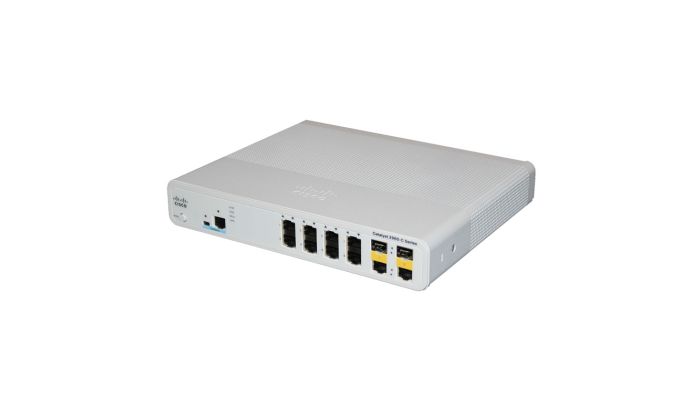
The Cisco Catalyst 2960C-8TC-L is an eight-port Fast Ethernet compact switch with 2 dual-purpose uplinks, the LAN Base image, an internal power supply and no Power over Ethernet on any port. Its chassis measures 1.75 inches high, 10.6 inches wide and 8.4 inches deep, well under a rack width, accordingly fitting a desk, a cabinet or a wall box rather than a rack, and needing an outlet.
A switch that lives where people can see it
Compact switches are installed in occupied space far more often than rack switches are, and that changes what matters about them. This chassis is 10.6 inches wide and 8.4 inches deep, so it sits on a shelf behind a reception desk, inside a meeting-room table box, in a classroom cupboard or on a wall bracket in a corridor. It is visible, reachable and frequently within earshot of the people using the network it serves.
Two practical consequences follow. Physical security is worth thinking about, because a switch that anyone can reach is a switch anyone can unplug. And cosmetic condition genuinely matters on a used unit in a way it does not for a chassis buried in a rack, which is why compact switches are graded and photographed with more care before they are sold.
| Specification | Catalyst 2960C-8TC-L |
|---|---|
| Part number | WS-C2960C-8TC-L |
| Access ports | 8 x 10/100 Fast Ethernet |
| Power over Ethernet | None |
| Uplinks | 2 dual-purpose, one port active per pair |
| Power supply | Internal, mains connected |
| Software image | LAN Base |
| Height | 1.75 in |
| Width | 10.6 in |
| Depth | 8.4 in |
Eight ports, and why that is often the right number
Eight access ports covers the great majority of single-room requirements: a meeting room with a display, a codec, a table box and a wall point; a reception area with two terminals, a printer and a card reader; a small office with half a dozen desks. Buying twenty-four ports for those rooms wastes both money and space, and the space is usually the scarcer of the two.
Where eight is not enough, the twelve-port powered model in the same compact family is the next step up, and beyond that the requirement has usually become a rack-width one served from a comms room rather than a local switch.
It is also worth counting the uplink in that arithmetic. One of the two dual-purpose pairs carries the connection back to the comms room, so eight access ports means eight endpoints and no more. Rooms that will grow to nine or ten devices should be specified at the twelve-port model rather than at this one, because there is no expansion path on a compact chassis and adding a second switch in a small room is rarely tidy.
An internal supply, and a mains outlet to plan for
This model has its own internal power supply and needs a mains socket at the point of installation. That sounds obvious until the installation point is a table box, a wall cavity or a ceiling void with structured cabling and no power. The CPD models in the same compact family exist precisely for those locations, drawing their power over an uplink instead, and the choice between the two is decided by the part number rather than by any setting.
Dual-purpose uplinks on a compact chassis
Each of the two uplinks holds a copper Gigabit port and an SFP slot, with one active at a time, giving two usable paths from four connectors. In compact deployments the copper side carries almost all real traffic, because these switches are reached over structured cabling from a comms room. The SFP option matters where a satellite building or an outbuilding is served over fibre and no copper run is possible.
Where the 8TC-L sits in the compact 2960-C range
The compact models differ by port count, access port speed and how each one is powered. This is the Fast Ethernet, data-only, mains-powered member.
| Model | Access ports | Port speed | PoE | Power source |
|---|---|---|---|---|
| 2960C-8TC-L | 8 | 10/100 | None | Internal supply |
| 2960CG-8TC-L | 8 | 10/100/1000 | None | Internal supply |
| 2960C-12PC-L | 12 | 10/100 | 124 W | Internal supply |
Where the requirement is a full closet with Gigabit access and a 10 Gigabit uplink, the Catalyst 2960S-48FPD-L is the rack-width answer. The current-generation counterpart for managed access switching is a Catalyst 9300 24-port model, part of the wider Catalyst 9300 family.
Support position for the compact line
This page publishes no lifecycle dates, because the Catalyst 2960-C compact line has no Cisco end-of-life notice in our verified source material. Dates appear elsewhere across our Catalyst 2960 pages only where a named Cisco announcement supports them, and the same rule is applied here rather than relaxed to fill the section.
Anyone planning a support position should look the part number up in Cisco's own end-of-life listing directly. Dates published for the rack-width sub-series cover different hardware, and the shared family name is not evidence that the compact models were announced on the same schedule.
Condition, testing and what ships
Refurbished enterprise hardware carrying the original Cisco part number. Each unit is tested on receipt, then disassembled, cleaned, inventoried and returned to stock; at order time it is rebuilt, configured and bench tested again before packing. Whole systems including this switch carry the 2-year Enterasource warranty, and shipping is free FedEx Ground to the lower 48 states.
Because compact switches are usually installed in visible locations, the external condition of the case is graded and recorded per unit rather than described in general terms. Mounting hardware and SFP transceivers are separate line items, and Cisco software entitlement does not transfer with used hardware.
Frequently Asked Questions
Where is a Catalyst 2960C-8TC-L normally installed?
In occupied space rather than a rack. At 10.6 inches wide and 8.4 inches deep it fits a shelf behind a reception desk, a meeting-room table box, a classroom cupboard or a wall bracket. That is the purpose of the compact line: managed switching in rooms that have structured cabling but no rack and no space to install one.
Does the Catalyst 2960C-8TC-L supply Power over Ethernet?
No. It has no power controller and no budget, so telephones, cameras and access points connected to it need their own supplies or an injector. Within the same compact family the 12-port model carries a 124 W budget, and the CPD models pass power through from an upstream switch, so a powered requirement is met by a different part number rather than by this one.
Does this compact switch need a mains socket?
Yes. It carries an internal power supply and has to be plugged in at the point of installation. That is the practical difference from the CPD models in the same family, which have no internal supply and take their power over an uplink cable. For a table box or ceiling void with cabling but no socket, a CPD model is the correct choice.
How many uplinks does a Catalyst 2960C-8TC-L have?
Two usable paths, from two dual-purpose uplinks that each contain a copper Gigabit port and an SFP slot with one active at a time. Compact installations almost always use the copper side, since the switch is reached over structured cabling. The SFP option covers outbuildings and satellite locations served over fibre where no copper run exists.
Is cosmetic condition more important on a compact switch?
In practice yes, because it is usually visible to the people using the room rather than hidden in a rack. Every compact unit is graded on external case condition specifically and that grade is recorded against the individual serial and published on its listing, alongside the two bench tests every unit receives on receipt and before packing. The catalogue is on the Cisco networking hardware page.