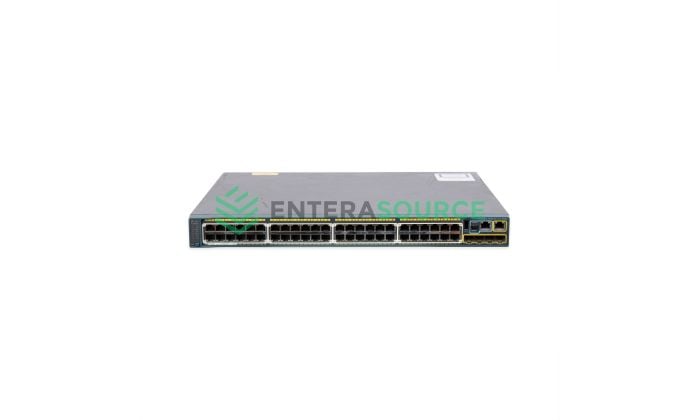
The Cisco Catalyst 2960S-48FPS-L is a 1U wiring-closet access switch with 48 Gigabit Ethernet ports that all support IEEE 802.3at PoE+ and 4 SFP uplink slots running at 1 Gbps. Combined PoE and PoE+ budget across the front panel is 740 W, and the software image is LAN Base rather than LAN Lite, which cannot be upgraded on this hardware generation.
Ports, PoE budget and uplinks
The 740 W PoE budget is the figure that decides what this switch can be deployed for, and it is a shared pool rather than a per-port allocation. An 802.3at PoE+ device can draw up to 30 W, so 740 W supports 24 ports at full PoE+ draw. An 802.3af device draws up to 15.4 W, so the same budget covers all 48 ports at the older class. Most real closets sit in between, because desk phones draw well under 15 W while outdoor access points and pan-tilt-zoom cameras sit at the top of the range.
| Specification | Catalyst 2960S-48FPS-L |
|---|---|
| Access ports | 48 x 10/100/1000 Ethernet |
| PoE standard | IEEE 802.3af and 802.3at PoE+, up to 30 W per port |
| PoE budget | 740 W combined |
| Uplinks | 4 x SFP, 1 Gbps |
| Software image | LAN Base |
| Forwarding rate | 77.4 mpps |
| Forwarding bandwidth | 88 Gbps |
| Switching bandwidth | 176 Gbps |
| Active VLANs | 255 |
| Flash / DRAM | 64 MB / 128 MB |
| Rack height | 1U, 1.75 x 17.5 x 15.2 in |
Stacking and how the 2960-S scales
Stacking on the 2960-S is FlexStack, and it runs at 20 Gbps of stack throughput once the optional FlexStack module is fitted. The module is not included in the base switch, which is the single most common gap in a used 2960-S purchase: the chassis is bought, the stack is planned, and the module turns out to be a separate part. A stack of 2960-S switches is managed as one logical unit with one configuration and one IP address, which is why the feature is worth the module cost in a closet running more than two switches.
FlexStack-Plus on the later 2960-X is backward compatible with FlexStack, so a 2960-X LAN Base switch with a FlexStack-Plus module can stack with a 2960-S or 2960-SF LAN Base switch. The mixed stack runs at 40 Gbps with a 4-member limit rather than the 80 Gbps and 8 members a pure 2960-X stack reaches. A 2960-XR cannot join a stack with either of them in any direction.
Software image: what LAN Base gives you
LAN Base is the mid-tier 2960 image and it is what this switch ships with. It carries 255 active VLANs, 88 Gbps of forwarding bandwidth and 176 Gbps of switching bandwidth. The LAN Lite image on cheaper 2960-S models is capped at 64 VLANs and 50 Gbps of forwarding, and Cisco states plainly that LAN Lite models cannot be upgraded to the LAN Base feature set. That is a hardware-level distinction on this generation, not a licence purchase, so a LAN Lite unit bought by mistake stays LAN Lite for its whole service life.
Power: there is no internal second supply, but an external one is supported
The 2960-S carries a single fixed internal power supply. Redundancy is available externally through the Cisco Redundant Power System 2300, which Cisco documents for this series along with the associated cable, power module, blower and blank parts. That distinction matters when a closet has an uptime requirement: the answer is not that the switch has no redundancy option, it is that redundancy is a separate external chassis rather than a second module fitted inside this one.
Where the 2960S-48FPS-L sits in the 2960 range
Within the 2960-S sub-series the difference between the 48-port PoE models is entirely in the uplinks, not in the PoE budget. This switch and the 48FPD-L both carry 48 Gigabit ports and the same 740 W budget; the FPD takes 2 SFP+ uplinks at 10 Gbps while this one takes 4 SFP uplinks at 1 Gbps.
| Model | Access ports | PoE budget | Uplinks | Forwarding rate |
|---|---|---|---|---|
| 2960S-48FPS-L | 48 Gigabit | 740 W | 4 x SFP, 1 Gbps | 77.4 mpps |
| 2960S-48FPD-L | 48 Gigabit | 740 W | 2 x SFP+, 10 Gbps | 101.2 mpps |
| 2960S-24PS-L | 24 Gigabit | 370 W | 4 x SFP, 1 Gbps | 41.7 mpps |
Choose the 2960S-48FPD-L where the closet uplinks to a 10G distribution layer. Choose this model where the uplinks are 1G fibre and the budget is better spent on ports than on optics. A step up to the Catalyst 2960X-48FPS-L buys four times the stack bandwidth and a longer Cisco support horizon on the same 48-port, 740 W layout.
Lifecycle and support horizon
Cisco covered the 2960-S and 2960-SF families in end-of-life notice EOL10043, and this model is named in it. End-of-Sale was 6 November 2015 and the Last Ship Date was 4 February 2016. Last Date of Support was 30 November 2020, and End of Vulnerability and Security Support was 5 November 2018. Every Cisco milestone on this platform has therefore passed.
Stated plainly: this is a switch you buy on price and on like-for-like replacement of an installed 2960-S, not on a forward support runway. Cisco's own stated migration path is the equivalent 2960-X model. Where an existing 2960-S stack needs a matching member, a spare for a failed unit, or a same-configuration replacement that will not disturb a working closet, that is exactly what this switch is for, and it is why demand for it has outlived its support window.
Condition, testing and what ships
Units are refurbished enterprise hardware carrying the original Cisco part number. Each switch is tested on receipt, then disassembled, cleaned, inventoried, picked, assembled, configured and tested again on the bench before it ships. Whole systems including this switch carry the 2-year Enterasource warranty, and shipping is free FedEx Ground to the lower 48 states.
The FlexStack module, SFP transceivers and rack ears are separate line items unless quoted with the switch, so a stack build should be specified as a whole rather than assumed to arrive complete. Cisco software licensing is not included with used hardware.
Frequently Asked Questions
How many PoE+ devices can a Catalyst 2960S-48FPS-L actually power?
Twenty-four devices at the full 30 W an 802.3at PoE+ endpoint is allowed to draw, because the shared budget is 740 W. At the older 802.3af class of 15.4 W the same budget covers all 48 ports. In practice a closet of desk phones drawing 6 to 10 W each will fill every port with headroom left, while a floor of outdoor access points and heated cameras will run out of watts long before it runs out of ports. Size on the watt figure, not the port count.
Does the Catalyst 2960-S stack, and what does it stack with?
Yes, using FlexStack at 20 Gbps of stack throughput, but only once the optional FlexStack module is fitted, because it is not built into the chassis. A 2960-S LAN Base switch stacks with other 2960-S and 2960-SF LAN Base switches, and it will also join a stack with a 2960-X LAN Base switch fitted with a FlexStack-Plus module. That mixed stack drops to 40 Gbps and a maximum of 4 members.
What is the difference between LAN Base and LAN Lite on a Catalyst 2960-S?
LAN Base carries 255 active VLANs with 88 Gbps of forwarding bandwidth; LAN Lite is capped at 64 VLANs and 50 Gbps. LAN Base also unlocks the stacking and routed-access features a LAN Lite unit does not offer. Cisco states that LAN Lite models cannot be upgraded to the LAN Base feature set, so the image is fixed at purchase and cannot be bought up later on the same chassis.
Is the Cisco Catalyst 2960-S still supported by Cisco?
No. Under notice EOL10043 the End-of-Sale date was 6 November 2015, the Last Ship Date was 4 February 2016, End of Vulnerability and Security Support was 5 November 2018 and the Last Date of Support was 30 November 2020. All of those milestones have passed, so Cisco provides neither hardware service nor software fixes for this platform. Cisco's stated migration product is the equivalent Catalyst 2960-X model.
What uplinks does the 2960S-48FPS-L take?
Four SFP slots running at 1 Gbps. The trailing S in the model designation is what signals 1G SFP uplinks across this sub-series, while a trailing D signals SFP+ slots that also run at 10 Gbps. Transceivers are not included with the switch. If the distribution layer is already 10G, the 48FPD-L is the model that matches it without an intermediate media converter or a wasted uplink pair.
What condition are your refurbished Catalyst 2960 switches in, and what testing do they get?
Every unit is refurbished enterprise hardware bearing the original Cisco part number. The process is inbound test on receipt, then disassembly, cleaning, inventory, pick, assembly, configuration and a final outbound test on the bench before the switch is packed. Cosmetic condition is recorded per unit and any physical defect is disclosed on the listing rather than discovered on delivery. The wider range is on the Cisco networking hardware page.