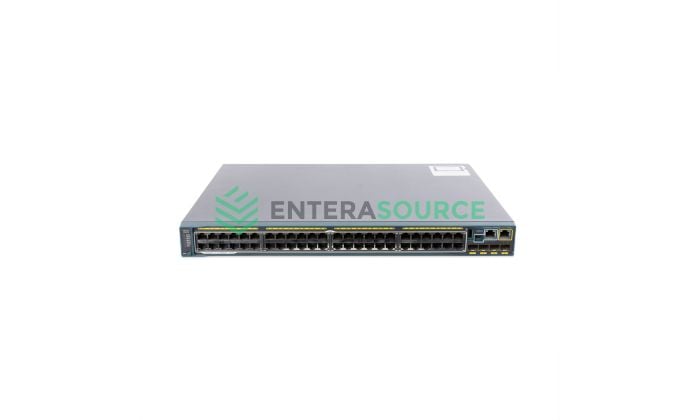
Cisco's Catalyst 2960S-F48LPS-L is the reduced-power 48-port member of the Fast Ethernet 2960-SF range, with a 370 W PoE budget, 4 SFP uplink slots at 1 Gbps and the LAN Base image. LP in the middle of that designation is Cisco's own marker for low-power PoE right across the sub-series, specifically halving the budget against the FP model while leaving everything else identical.
370 W across 48 ports: the arithmetic that decides this purchase
This is the number to work out before ordering, and it is rarely spelled out. The switch has 48 access ports and a shared 370 W pool. At the 15.4 W ceiling of an 802.3af endpoint, 370 W stretches to 24 ports. At the 30 W ceiling of an IEEE 802.3at PoE+ endpoint it stretches to 12. In other words this chassis cannot power every one of its ports even at the lowest standard class, and it was never intended to.
That is not a flaw; it is the design point. Half-populated PoE is the normal condition in a mixed closet where telephones sit next to unpowered desktops. Buying the full-budget model to power 20 telephones spends money on watts that will never be drawn. The decision is simply whether the count of powered endpoints will stay under 24 at the low class, and the honest answer is usually known at design time.
| Specification | Catalyst 2960S-F48LPS-L |
|---|---|
| Access ports | 48 x 10/100 Fast Ethernet |
| PoE budget | 370 W combined |
| Ports at the 15.4 W PoE ceiling | 24 |
| Ports at the 30 W PoE+ ceiling | 12 |
| Uplinks | 4 x SFP, 1 Gbps |
| Software image | LAN Base |
| Forwarding bandwidth | 88 Gbps |
| Switching bandwidth | 176 Gbps |
| Active VLANs | 255 |
| Rack height | 1U, 1.75 x 17.5 x 15.2 in |
What LP changes, and what it leaves alone
Only the power pool changes. The 48 Fast Ethernet access ports, the 4 SFP uplink slots at 1 Gbps, the LAN Base image with its 255 active VLANs, the 88 Gbps of forwarding bandwidth, the 176 Gbps of switching bandwidth, the 1U chassis and the FlexStack support are all identical to the full-budget model. This is the cleanest single-variable choice anywhere in the 2960-SF range, which makes it unusually easy to specify correctly.
It also means a low-power unit is a valid drop-in for a full-power one in any closet whose actual draw is under 370 W, and the reverse is true when a site's powered device count grows. Configuration transfers unchanged between the two because the software image, the interface names and the uplink layout are the same. The only thing that has to be re-checked is the summed class draw of the endpoints, which is the calculation that separated the two models in the first place.
Stacking and redundancy on this chassis
FlexStack runs at 20 Gbps here with the optional module fitted, and stacked members are managed as one logical switch. Cross-generation stacking with a 2960-X LAN Base switch carrying a FlexStack-Plus module is supported at a reduced 40 Gbps with a four-member ceiling. Redundant power is external through the Cisco Redundant Power System 2300; there is no second supply bay inside this chassis, which is worth confirming at design time rather than at installation.
One practical note on mixed stacks in a voice closet: the PoE budget is not pooled across stack members. Each chassis powers its own ports from its own supply, so a stack of two low-power units gives two separate 370 W pools rather than one of 740 W, and an endpoint plugged into the wrong member can be refused power while the other member has watts to spare.
Where the F48LPS-L sits in the 2960-SF range
The comparison that decides this model is against the full-budget 48-port Fast Ethernet switch and against the 24-port model with the same 370 W pool. Those two frame the question precisely: more watts, or fewer ports for the same watts.
| Model | Access ports | PoE budget | Ports at 15.4 W | Uplinks |
|---|---|---|---|---|
| 2960S-F48LPS-L | 48 Fast Ethernet | 370 W | 24 | 4 x SFP |
| 2960S-F48FPS-L | 48 Fast Ethernet | 740 W | 48 | 4 x SFP |
| 2960S-F24PS-L | 24 Fast Ethernet | 370 W | 24 | 2 x SFP |
If every port has to be powered, the full-budget model is the only correct answer in this branch of the sub-series. If Gigabit access is needed alongside power, the Catalyst 2960S-48FPS-L is the model to specify. A current-generation equivalent is a Catalyst 9300 48-port model, and the routing tier above a closet like this is typically a Cisco ISR 4331.
Lifecycle and support horizon
Cisco named this model in end-of-life notice EOL10043 alongside the rest of the 2960-S and 2960-SF families. End-of-Sale was 6 November 2015, the Last Ship Date was 4 February 2016, End of Software Maintenance was 5 November 2016, End of Vulnerability and Security Support was 5 November 2018 and the Last Date of Support was 30 November 2020.
Every milestone in that notice has passed, so Cisco provides neither software fixes nor hardware service and no new contract can be attached. Sites still running these switches cover them with spares holding or third-party support, which is the normal and rational arrangement for a Fast Ethernet voice closet that works and has no reason to change.
Condition, testing and what ships
Units are refurbished enterprise hardware carrying Cisco's original part number. Testing happens on receipt and again on despatch, with disassembly, cleaning, inventory, assembly and configuration between the two. Whole systems including this switch carry the 2-year Enterasource warranty and ship free by FedEx Ground to the lower 48 states.
The FlexStack module, SFP transceivers, rack ears and any external redundant power components are separate line items unless quoted with the chassis. Cisco software entitlement does not transfer with used hardware.
Frequently Asked Questions
How many ports can a 2960S-F48LPS-L actually power?
Twenty-four at the 15.4 W ceiling of an 802.3af endpoint, or twelve at the 30 W ceiling of an IEEE 802.3at PoE+ endpoint, from a shared 370 W pool. That means this switch cannot power all 48 of its ports at any standard class. If every port must be powered, the full-budget variant of the same chassis is the model that does it.
What does LP mean in the Catalyst 2960S-F48LPS-L designation?
It marks the low-power PoE budget. Across this sub-series FP denotes the full pool, which on a 48-port model is 740 W, and LP denotes the reduced pool of 370 W. The letters that follow describe the uplinks and the software image, so a single pair of characters in the middle of the designation is what separates two otherwise identical switches.
Is anything other than the PoE budget different between the LP and FP models?
No. Access port count and speed, uplink count and type, software image, VLAN ceiling, forwarding and switching bandwidth, chassis height and stacking support are all identical. The power pool is the single variable, which makes this one of the few genuinely one-dimensional choices in the Catalyst 2960 catalogue and one of the easiest to get right.
Can a 2960S-F48LPS-L stack with newer Catalyst switches?
It stacks with 2960-S and 2960-SF LAN Base switches at 20 Gbps using FlexStack, and with a 2960-X LAN Base switch fitted with a FlexStack-Plus module at a reduced 40 Gbps and a four-member limit. It will not stack with a 2960-XR in either direction, and it will not join a stack of any later Catalyst generation.
What is checked on a refurbished 2960S-F48LPS-L before despatch?
Each chassis is tested inbound, cleaned, inventoried and stored as known-good stock, then rebuilt to the order, configured and tested again on the bench immediately before packing. The power stage is exercised as part of that outbound test. Cosmetic condition is graded per unit and any fault is disclosed on that unit's listing. Everything else is on the Cisco networking hardware page.