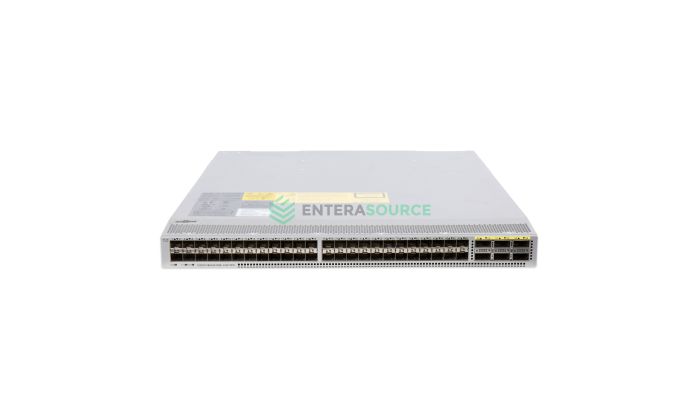
The Cisco Nexus 9372PX is a 1RU top-of-rack switch with 48 fixed SFP+ ports running at 10 Gbps and 6 fixed QSFP+ ports running at 40 Gbps. It forwards 1.44 Tbps and over 1150 million packets per second, and every port on it is fixed, which means there is no uplink module bay to populate later, and no module to buy alongside the chassis.
Ports, capacity and the fixed-uplink design
Fixed ports are the defining characteristic of this switch and the first thing to check against a bill of materials. The 48 SFP+ access ports and the 6 QSFP+ uplink ports are soldered configuration, not a modular slot, so a Nexus 9300 uplink module such as the M12PQ does not fit this chassis and cannot be added to it. Where a design calls for a 12-port 40G uplink module, the host has to be a 9396PX, a 9396TX or a 93128TX instead.
| Specification | Nexus 9372PX |
|---|---|
| Rack height | 1RU |
| Access ports | 48 x SFP+, 10 Gbps, fixed |
| Uplink ports | 6 x QSFP+, 40 Gbps, fixed |
| Switching capacity | 1.44 Tbps |
| Forwarding rate | Over 1150 mpps |
| Shared packet buffer | 25 MB additional |
| System memory | 16 GB |
| Onboard storage | 64 GB SSD |
| Fans | 4 |
| Typical power draw | 210 W |
| Maximum power draw | 537 W |
| Weight | 22.2 lb |
Layer 3 routing is licensed, not included
Routing is the claim most often made loosely about this platform and it deserves an exact answer. Cisco states that the default system software carries a comprehensive Layer 2 security and management feature set, and that enabling additional functions including Layer 3 IP unicast and IP multicast routing requires additional licences. The enhanced Layer 3 licence covering full OSPF, EIGRP and BGP is a separate Cisco part.
Refurbished hardware does not carry transferable Cisco software entitlement, so a 9372PX bought on the secondary market should be planned as a Layer 2 switch unless the buyer already holds or intends to buy the routing licence separately. Describing it as a managed Layer 3 switch without that qualifier oversells what actually arrives in the box.
Power supplies, redundancy and the 110 V constraint
Power options on this platform include 650 W AC, 930 W DC and 1200 W high-voltage AC and DC supplies. One constraint is worth stating before a rack design is finalised: Cisco documents that power supply redundancy is not supported when the switch is used at 110 V. A design that assumes dual-supply resilience on a standard North American 110 V circuit is a design that does not get it, and the fix is a 200 to 240 V feed rather than a different supply.
Environmental limits are 32 to 104 degrees Fahrenheit, 5 to 95 percent relative humidity non-condensing, and an operating altitude range from sea level to 4000 metres.
Where the 9372PX sits in our Nexus range
Two comparisons cover almost every 9372PX enquiry: the copper version of the same switch, and the newer 25G-capable leaf that replaced this generation.
| Model | Access ports | Uplinks | Capacity | Forwarding |
|---|---|---|---|---|
| Nexus 9372PX | 48 x 10G SFP+ | 6 x 40G QSFP+ | 1.44 Tbps | Over 1150 mpps |
| Nexus 9372TX | 48 x 100M/1/10G BASE-T | 6 x 40G QSFP+ | 1.44 Tbps | 1150 mpps |
| Nexus 93180YC-EX | 48 x 1/10/25G SFP28 | 6 x 40/100G QSFP28 | 3.6 Tbps | 2.6 bpps |
Choose the Nexus 9372TX where the servers present copper BASE-T rather than fibre; the switching capacity and uplinks are identical and only the access media changes. Step to the Nexus 93180YC-EX where 25G access, 100G uplinks or a live Cisco support window are requirements. Both sit within the Cisco networking hardware range.
Lifecycle and support horizon
Cisco end-of-life notice EOL11922 covers this switch. End-of-Sale for the hardware was 3 February 2018 and the Last Ship Date was 4 May 2018. End of Vulnerability and Security Support and the Last Date of Support for the hardware both fell on 28 February 2023.
Cisco support for this platform is therefore closed, and that is the frame a buyer should work from. A 9372PX is bought today to extend, spare or replace an installed fabric that is already running this generation, where matching the existing hardware matters more than a forward support runway. For a new build with a multi-year horizon, the 93180YC-EX is the honest recommendation instead.
Condition, testing and what ships
Units are refurbished enterprise hardware carrying the original Cisco part number. Each switch is tested on receipt, then disassembled, cleaned, inventoried, picked, assembled, configured and tested again on the bench before despatch. Whole systems including this switch carry the 2-year Enterasource warranty, and shipping is free FedEx Ground to the lower 48 states.
Power supplies and fan trays are supplied to a stated airflow direction rather than an assumed one. Optics are quoted separately. Cisco software licensing, including any Layer 3 entitlement, is not included and does not transfer with used hardware.
Frequently Asked Questions
Can a Nexus 9372PX take an uplink module?
No. All 54 ports on this switch are fixed, so there is no module bay and a Nexus 9300 uplink module cannot be installed in it. Cisco documents the M12PQ 12-port 40G module as fitting the 9396PX, the 9396TX and the 93128TX only, at 12, 12 and 8 active ports respectively. A design that needs a modular uplink path has to start from one of those chassis.
Is the Cisco Nexus 9372PX a Layer 3 switch?
Only with the appropriate licence. Cisco ships the default system software with a Layer 2 feature set, and states that Layer 3 IP unicast and multicast routing require additional licences, with full OSPF, EIGRP and BGP sitting behind the enhanced Layer 3 licence. Because software entitlement does not transfer with refurbished hardware, plan a secondary-market unit as a Layer 2 switch unless routing licences are held separately.
What is the difference between the Nexus 9372PX and the 9372TX?
Access media, and only that. The PX presents 48 SFP+ ports for 10 Gigabit fibre or direct-attach copper, while the TX presents 48 BASE-T ports for 100 Megabit, 1 Gigabit or 10 Gigabit twisted pair. Both carry 6 fixed 40 Gigabit QSFP+ uplinks, 1.44 Tbps of switching capacity and the same 1150 million packets per second forwarding rate.
Does the Nexus 9372PX support redundant power at 110 V?
No. Cisco documents that power supply redundancy is not supported when the switch is run at 110 V, which makes a dual-supply design on a standard 110 V circuit ineffective. Delivering genuine supply redundancy on this platform requires a 200 to 240 V feed. Available supplies are 650 W AC, 930 W DC and 1200 W high-voltage AC and DC.
Is the Nexus 9372PX still supported by Cisco?
No. Under notice EOL11922 the End-of-Sale date was 3 February 2018, the Last Ship Date was 4 May 2018, and both the End of Vulnerability and Security Support and the Last Date of Support for the hardware fell on 28 February 2023. No Cisco hardware service or software fix is available for this platform now, so it is bought to match an installed fabric rather than to start a new one.
What testing does a refurbished Nexus switch receive before it ships?
Two passes on every chassis. The first happens on receipt and establishes that the hardware is sound before it enters stock; the unit is then disassembled, cleaned and inventoried. The second happens after the switch has been picked, reassembled and configured for the order, immediately before it is packed. Any physical defect identified at either stage is recorded against that specific unit and published on its listing.