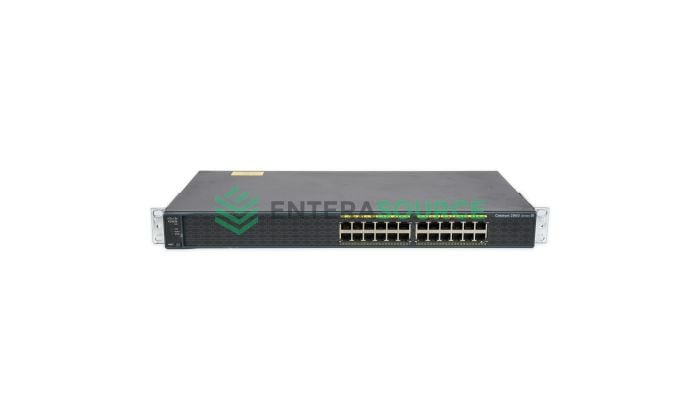
The Cisco Catalyst 2960-24-S is a 24-port Layer 2 access switch with 10/100 Ethernet access ports, the LAN Lite image, and no uplink ports of any kind. That last point is the one buyers most often get wrong: every one of the ports on the front panel is an access port with no dedicated uplink, consequently an uplink consumes one of the 24 rather than arriving on its own slot.
Twenty-four ports and no uplink slot
Cisco's own description of this switch is "24 Ethernet 10/100 ports" with LAN Lite software, and the data sheet does not list a separate uplink. That is unusual even among entry-level switches, and it changes the usable port count in a way that only becomes obvious at installation. A switch connected to a distribution layer over one of its own access ports has 23 ports left for endpoints, not 24.
It also fixes the uplink speed at 100 Mbps, because every port on this chassis is Fast Ethernet. There is no Gigabit port, no SFP cage and no combo port to reach a faster distribution layer through. For a room of twenty low-bandwidth endpoints that is workable; for anything that aggregates it is the constraint that decides against this model.
| Specification | Catalyst 2960-24-S |
|---|---|
| Access ports | 24 x 10/100 Fast Ethernet |
| Dedicated uplink ports | None |
| Power over Ethernet | None |
| Software image | LAN Lite |
| Switching layer | Layer 2 |
| Cisco end-of-life notice | EOL9449 |
It is a Layer 2 edge switch
Cisco describes the Catalyst 2960-S and 2960 Series as the leading Layer 2 edge switches, and that is the correct frame for this model. It forwards on MAC addresses, handles VLANs, and does the work an access-layer switch is supposed to do. It is not a routing platform and should not be specified as one; any inter-VLAN routing behind it belongs on the distribution switch or the router above it.
This is worth stating plainly because switching-layer claims are the most commonly muddled specification in the secondary market. If a design document calls for Layer 3 routed access, this chassis does not satisfy it, and the requirement has to be met by the tier above or by a different switch entirely.
LAN Lite on the original 2960 generation
The trailing S in the model designation marks LAN Lite, the entry-level image. It is the smaller of the two feature sets offered across this generation and it is fixed at manufacture, so a LAN Lite chassis cannot be raised to the LAN Base feature set later by any licensing action. Combined with the absence of uplink ports, the image places this switch firmly at the simplest end of the range.
What a Fast Ethernet access layer still carries comfortably
One hundred megabits per port is far more than a large class of equipment will ever ask for, and that class has not gone away. Point-of-sale terminals, badge readers, door controllers, building management panels, industrial sensors, label printers and thin clients all operate well below that ceiling for their entire service lives. A switch that serves them at 100 Mbps is not underspecified; it is matched to the load.
Where the ceiling becomes a real constraint is anything that moves files, video or wireless traffic. A single modern access point can saturate a Fast Ethernet port on its own, and a desktop copying from a file server will notice the difference immediately. The useful test before buying is simply whether anything behind this switch will ever need more than 100 Mbps, because the answer cannot be changed later on this chassis.
Where the 2960-24-S sits in the classic 2960 range
Reading this switch against the 48-port members of the same generation shows exactly what it trades away: half the ports, and every uplink.
| Model | Access ports | Uplinks | Image | PoE |
|---|---|---|---|---|
| 2960-24-S | 24 Fast Ethernet | None | LAN Lite | None |
| 2960-48TC-S | 48 Fast Ethernet | 2 dual-purpose | LAN Lite | None |
| 2960-48TT-L | 48 Fast Ethernet | 2 x 1000BASE-T | LAN Base | None |
Where the requirement includes Gigabit access ports and powered endpoints, the Catalyst 2960S-48FPS-L is a later generation built for that job. For a current-generation 24-port access switch the counterpart is a Catalyst 9300 24-port model, and the routing that usually sits above a small site is a Cisco ISR 4321.
Lifecycle and support horizon
Cisco announced the classic Catalyst 2960 models in end-of-life notice EOL9449, which names this switch. End-of-Sale was 31 October 2014, the Last Ship Date was 29 January 2015 and End of Software Maintenance was 31 October 2015. End of Vulnerability and Security Support was 30 October 2017 and the Last Date of Support was 31 October 2019.
This is the oldest generation in the Catalyst 2960 family and every milestone on it closed years ago. The reason it still moves is break-fix: sites with a working installation need a matching unit when one fails, and a like-for-like replacement is far less disruptive than re-platforming a room that otherwise works. That is the use this page is written for, and it is not an argument for building anything new on it.
Condition, testing and what ships
Units are refurbished enterprise hardware carrying the original Cisco part number. Each switch is tested on receipt, then disassembled, cleaned, inventoried and returned to stock; on order it is picked, assembled, configured and bench tested again before packing. Whole systems including this switch carry the 2-year Enterasource warranty, and shipping is free FedEx Ground to the lower 48 states.
Rack hardware is a separate line item unless quoted with the switch. Cisco software entitlement is not included and does not transfer with used hardware, and the LAN Lite image on this chassis cannot be changed after purchase.
Frequently Asked Questions
Does a Catalyst 2960-24-S have an uplink port?
No. Cisco lists this model as 24 Ethernet 10/100 ports with LAN Lite software and no separate uplink, so a connection to the distribution layer consumes one of the 24 access ports. That leaves 23 for endpoints and fixes the uplink at 100 Mbps, since there is no Gigabit port, SFP cage or combo port anywhere on the chassis.
Is the Catalyst 2960-24-S a Layer 2 or a Layer 3 switch?
Layer 2. Cisco describes the Catalyst 2960-S and 2960 Series as the leading Layer 2 edge switches, and this model forwards on MAC addresses and handles VLANs rather than routing between them. Any inter-VLAN routing in a design that includes this switch has to be performed by the distribution switch or the router above it.
How fast are the ports on a Catalyst 2960-24-S?
All twenty-four run at 10/100 Fast Ethernet and none will negotiate to 1000 Mbps. This is the original 2960 generation, which predates the Gigabit access layer that the 2960-S and later sub-series introduced. Endpoints needing a Gigabit port require a different generation of switch entirely rather than a configuration change on this one.
Can the LAN Lite image on a 2960-24-S be upgraded?
No. The image is fixed at manufacture on this generation and there is no licence or software release that raises a LAN Lite chassis to the LAN Base feature set. The trailing S in the model designation is what marks it, so the feature ceiling should be checked against the requirement before purchase rather than treated as something to resolve later.
Why would anyone still buy a Catalyst 2960-24-S?
Almost always to replace one. Sites with a working installation of this generation need a matching unit when one fails, and dropping in an identical switch avoids a configuration migration and a change window. It is a break-fix and continuity part rather than a platform for new work, and that is a legitimate and common requirement. The wider range is on the Cisco networking hardware page.