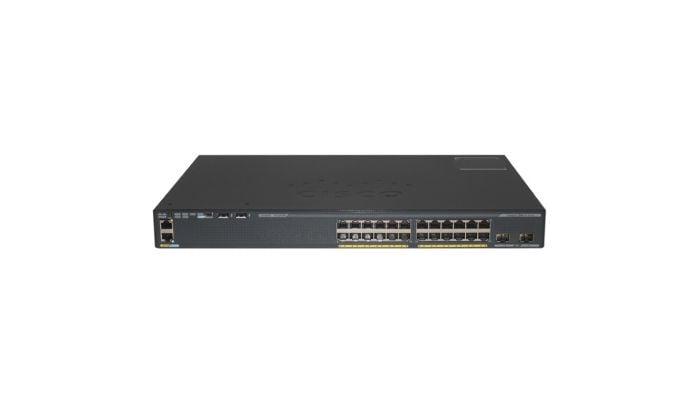
The Cisco Catalyst 2960X-24TD-L is the data-only 24-port member of the 2960-X range: 24 Gigabit access ports with no Power over Ethernet, 2 SFP+ uplink slots capable of 10 Gbps, LAN Base software and FlexStack-Plus stacking. Dropping the power stage drops both the watts and the heat load, importantly without giving up the 10 Gigabit uplink a modern distribution layer expects.
Twenty-four Gigabit ports and 20 Gbps of uplink
This is a small switch with a large exit. Twenty-four access ports at 1 Gbps sit behind 2 SFP+ slots that each run at 1 or 10 Gbps, for up to 20 Gbps of aggregate uplink. In oversubscription terms that is roughly 1.2 to 1, which is closer to an aggregation switch than to a typical access switch and is why this model turns up in server rooms and comms rooms at least as frequently as in wiring closets.
The SFP+ slots accept Gigabit optics as well, so the same chassis works behind a Gigabit core today and a 10 Gigabit one later. That matters on a data-only switch more than on a powered one, because a switch with no PoE stage tends to stay in service far longer than the network around it.
| Specification | Catalyst 2960X-24TD-L |
|---|---|
| Access ports | 24 x 10/100/1000 Ethernet |
| Power over Ethernet | None |
| Uplinks | 2 x SFP+, 1/10 Gbps |
| Software image | LAN Base |
| Forwarding bandwidth | 108 Gbps |
| Switching bandwidth | 216 Gbps |
| Active VLANs | 1023 |
| Stacking | FlexStack-Plus, 80 Gbps, 8 members |
| Rack height | 1RU, 1.75 in |
Behind the front panel the LAN Base image supplies 1023 active VLANs, 108 Gbps of forwarding bandwidth and 216 Gbps of switching bandwidth in a 1RU chassis, which is the same software platform the powered models in this sub-series run.
What a data-only chassis is worth in practice
No PoE controller means no shared power pool to manage, no thermal contribution from powered endpoints and one fewer subsystem that can fail. In a rack that is already tight on circuit capacity or airflow, that is a design advantage rather than a saving on paper. It also removes an entire category of fault report, because a switch that never sources power cannot be the cause of a device that stopped receiving it.
The counter-argument is straightforward and should be stated: if any endpoint behind this switch will ever need power, it will need an injector or a separate powered switch, and retro-fitting that into a live rack is more disruptive than specifying a powered model at the outset.
There is a purchasing consequence too. Data-only models are consistently the least expensive members of any Catalyst 2960 sub-series because the power stage is the costly part of the chassis, so a site that genuinely has no powered endpoints buys more ports and more uplink capacity for the same outlay by choosing the T variant. Where half a closet needs power and half does not, the usual answer is a small powered switch beside a larger data-only one rather than a single fully powered chassis.
Stacking at 80 Gbps
FlexStack-Plus gives this switch 80 Gbps of stack throughput across up to eight members on the LAN Base image, managed as a single logical switch with one configuration and one address. It is backward compatible with FlexStack on the 2960-S and 2960-SF, so a mixed stack is supported at 40 Gbps with four members. A 2960-XR will not stack with it in either direction. The FlexStack-Plus module and its cables are separate parts from the chassis.
Where the 24TD-L sits in the 2960-X range
Among the data-only 24-port models the variables are uplink media and software image. This one takes the 10 Gigabit uplinks and the full LAN Base feature set, which is the top of that particular ladder.
| Model | Uplinks | Image / VLANs | Stacking | PoE |
|---|---|---|---|---|
| 2960X-24TD-L | 2 x SFP+, 10 Gbps | LAN Base / 1023 | FlexStack-Plus | None |
| 2960X-24TS-L | 4 x SFP, 1 Gbps | LAN Base / 1023 | FlexStack-Plus | None |
| 2960X-24TS-LL | 2 x SFP, 1 Gbps | LAN Lite / 64 | None | None |
For the same 10 Gigabit uplink shape with 48 powered ports, the Catalyst 2960X-48FPD-L is the model to look at. The current-generation successor line is the Catalyst 9300 family, and where the same refresh takes in routing, a Cisco ISR 4331 is the usual counterpart.
Lifecycle and support horizon
Cisco's end-of-life notice EOL13603 covers the Catalyst 2960-X product family and names this model. End-of-Sale for the hardware was 31 October 2022, the Last Ship Date was 30 January 2023 and End of Software Maintenance was 31 October 2023. The Last Date of Support and End of Vulnerability and Security Support both fall on 31 October 2027, with End of Service Contract Renewal on 29 January 2027.
Buying a switch Cisco still supports but no longer sells is the clearest case there is for the secondary market, and a data-only chassis is the easiest version of that argument. There is no power supply working hard against a full PoE budget and no power controller to age, which is one reason units of this type turn up in excellent condition years after End-of-Sale.
Condition, testing and what ships
Every unit is refurbished enterprise hardware carrying the original Cisco part number. Testing runs on receipt and again on despatch, with disassembly, cleaning, inventory, assembly and configuration in between. Whole systems including this switch carry the 2-year Enterasource warranty, and delivery is free FedEx Ground to the lower 48 states.
SFP+ transceivers, FlexStack-Plus modules and stacking cables are separate lines unless quoted with the switch. Cisco software licensing is not included with used hardware.
Frequently Asked Questions
Does a Catalyst 2960X-24TD-L supply any Power over Ethernet?
No port on it sources power. The T in the model designation marks a data-only chassis across the whole 2960-X sub-series, where P denotes the 370 W budget on a 24-port model and FP or LP denote the two budgets on the 48-port models. Powered endpoints behind this switch require midspan injectors or their own local supplies.
Can the SFP+ uplinks on a 2960X-24TD-L run at 1 Gbps?
Yes. The uplink slots on the D models are dual-rate and accept either 1 Gbps or 10 Gbps transceivers, so the switch can be commissioned against an existing Gigabit fibre plant and moved to 10 Gigabit later without being replaced. Transceivers are not supplied with the chassis and should be matched to the fibre type and reach in use.
How oversubscribed is a 2960X-24TD-L?
Barely. Twenty-four Gigabit access ports total 24 Gbps against up to 20 Gbps of uplink across the two SFP+ slots, which is roughly 1.2 to 1. That is why the model is often deployed as a small aggregation switch or in a server room rather than as a conventional wiring-closet access switch where a much higher ratio would be normal.
Will a 2960X-24TD-L stack with a 2960-XR?
No, and not in either direction. FlexStack-Plus on the 2960-X stacks with other 2960-X switches at 80 Gbps across eight members, and with 2960-S or 2960-SF LAN Base switches at a reduced 40 Gbps with four members. The 2960-XR is a separate stacking domain and only stacks with other 2960-XR switches.
What is done to a refurbished 2960X-24TD-L before it ships?
It is tested on arrival to establish that the fabric and both uplink slots are sound, then stripped, cleaned and inventoried into stock. When the order is picked the chassis is reassembled, configured to specification and bench tested a second time immediately before packing. Cosmetic grading is recorded per unit and any defect appears on its listing. Everything else is on the Cisco networking hardware page.