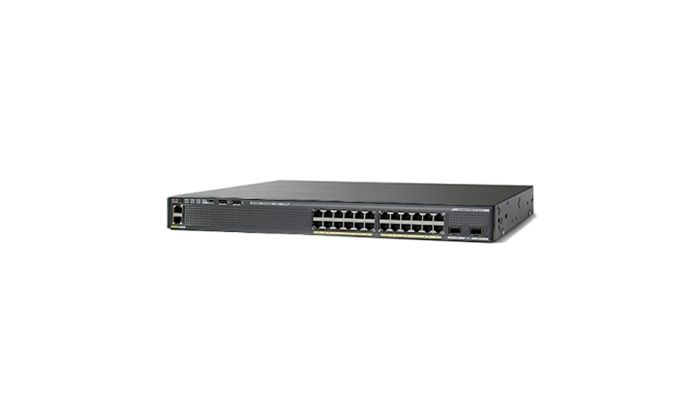
Cisco's Catalyst 2960XR-24PS-I combines 24 Gigabit PoE+ access ports, 4 SFP uplink slots at 1 Gbps and the IP Lite image with a power architecture the 2960-X does not have. The chassis holds two internal power supply bays, one of them already populated when the switch leaves the factory, together holding a 370 W Power over Ethernet budget up through the loss of either module.
Internal redundancy against an external chassis
The distinction between the 2960-XR and the 2960-X is often described as redundancy against none, and that is wrong. Cisco documents an external redundant power supply option for the Catalyst 2960-X Series through the Redundant Power System 2300, and dual redundant power supplies for the Catalyst 2960-XR Series inside the switch itself. Both families can be made resilient. What differs is where the second supply lives and what it costs to deploy.
The practical consequences are concrete. An external redundant system occupies its own rack space, needs its own cabling to each protected switch, and has to be planned into the closet before the switches are installed. Two internal field-replaceable bays occupy no extra rack units, need no interconnect and can be filled at any point in the switch's life by someone with physical access and no design work at all.
| Specification | Catalyst 2960XR-24PS-I |
|---|---|
| Access ports | 24 x 10/100/1000 Ethernet |
| Uplinks | 4 x SFP, 1 Gbps |
| Software image | IP Lite |
| Available PoE, one or two supplies | 370 W |
| Ports at up to 30 W PoE+ | 12 |
| Ports at up to 15.4 W PoE | 24 |
| PoE retained if one supply fails | 370 W |
| Power supply | PWR-C2-640WAC, 2 bays, one populated by default |
| Stacking | FlexStack-Plus, 80 Gbps, 8 members |
What the two budget figures mean at the port level
The budget is 370 W and Cisco publishes what it covers directly: 12 ports at up to 30 W for a PoE+ endpoint, or 24 ports at up to 15.4 W for standard PoE. Both figures hold whether one supply is fitted or two, because the second module is a redundancy component and not a second source of Power over Ethernet.
For a closet of desk telephones the 24-port figure means the whole front panel is coverable. For a floor of wireless access points the binding number is 12, and the decision the second bay actually settles is what happens to those 12 when a power supply dies: with both bays populated Cisco's table shows the full 370 W still available, so none of them drop.
Four Gigabit uplinks on a resilient chassis
This model carries 4 SFP slots fixed at 1 Gbps rather than the 2 SFP+ slots on the D variant. On a switch bought for resilience that combination is coherent: four slots allow two links to each of two distribution switches, so the closet keeps a working path through the loss of a fibre, a transceiver or an entire upstream device. Pairing four diverse uplinks with two internal supplies removes both of the common single points of failure in a wiring closet.
The IP Lite image
Every model in the 2960-XR sub-series runs IP Lite, which is what the trailing I in the designation marks. It sits above the LAN Base image carried across the 2960-X family and is the reason the XR is specified where the access layer is expected to do routed work rather than pure Layer 2 switching. The image is not a licence choice on this hardware; it is what the sub-series ships with.
Where the 24PS-I sits in the 2960-XR range
The 24-port XR models differ in uplink media and in whether they source power. Neither power column below varies with the number of supplies fitted; the second reports what a chassis with both bays populated still delivers after one fails.
| Model | Uplinks | PoE budget | PoE retained if a supply fails |
|---|---|---|---|
| 2960XR-24PS-I | 4 x SFP, 1 Gbps | 370 W | 370 W |
| 2960XR-24PD-I | 2 x SFP+, 10 Gbps | 370 W | 370 W |
| 2960XR-24TS-I | 4 x SFP, 1 Gbps | None | None |
Where 48 powered ports are needed and internal redundancy is not, the Catalyst 2960X-48FPS-L is the LAN Base equivalent with the same uplink layout. The current-generation counterpart at this port count is a Catalyst 9300 24-port model, and the routing tier above a closet built for resilience is usually drawn from the Cisco ISR 4000 family.
Lifecycle and support horizon
Cisco announced the Catalyst 2960-XR product family in end-of-life notice EOL13602, which names all ten models. End-of-Sale for the hardware was 31 October 2022, the Last Ship Date was 30 January 2023 and End of Software Maintenance was 31 October 2023. The Last Date of Support and End of Vulnerability and Security Support both fall on 31 October 2027, and End of Service Contract Renewal is 29 January 2027.
Every one of those dates matches the Catalyst 2960-X family notice exactly. The XR does not outlive the X and should not be bought on the assumption that it does. Its case rests on the internal supply bays, on the 370 W budget surviving a supply failure intact, and on the IP Lite image, all of which are hardware and software properties rather than calendar ones.
Condition, testing and what ships
Refurbished enterprise hardware carrying the original Cisco part number. Each unit is tested on receipt, then disassembled, cleaned, inventoried and returned to stock; at order time it is rebuilt to the requested specification, configured and bench tested again before packing, with each fitted supply exercised individually. Whole systems including this switch carry the 2-year Enterasource warranty, and delivery is free FedEx Ground to the lower 48 states.
The supply count is confirmed at the point of order rather than assumed, since the chassis has two bays and ships with one filled. SFP transceivers, stacking modules and cables are separate line items. Cisco software entitlement does not transfer with used hardware.
Frequently Asked Questions
Does a Catalyst 2960-X have no power redundancy at all?
It has redundancy, but externally. Cisco supports the Redundant Power System 2300 for the Catalyst 2960-X Series, which is a separate chassis cabled to each protected switch. The 2960-XR brings the same protection inside the switch as two field-replaceable bays. The difference is rack space, cabling and design effort rather than whether resilience is available.
How many PoE+ devices can a 2960XR-24PS-I power?
Twelve at the full 30 W an IEEE 802.3at endpoint may draw, or all twenty-four at the 15.4 W standard PoE class, from the 370 W budget. Cisco publishes both counts per model and neither one changes with the number of power supplies installed. The second supply does not raise the count; it keeps the count intact through a supply failure, which on a room of cameras or access points is the outcome that matters.
Why does this model have four uplinks instead of two faster ones?
Because it is built around path diversity. Four SFP slots at 1 Gbps allow two links to each of two distribution switches, so the closet survives the loss of a fibre, a transceiver or an entire upstream chassis. On a switch already carrying two internal power supplies, removing the second common single point of failure is a coherent design rather than a bandwidth compromise.
What does the I mean at the end of a 2960-XR model designation?
The IP Lite software image, which every model in the Catalyst 2960-XR sub-series carries. It sits above the LAN Base image used across the 2960-X family. The image is fixed by the part number rather than chosen by licence, so an XR is an IP Lite switch by definition and there is no LAN Base variant of the same chassis.
What is verified on a used 2960XR-24PS-I before it ships?
The chassis is bench tested on arrival, then cleaned, inventoried and held as known-good stock. On sale it is rebuilt to the ordered configuration including the specified number of power supplies, configured, and tested again immediately before packing with each supply and all four SFP slots exercised. Condition is graded per serial and published on that listing. The range is on the Cisco networking hardware page.