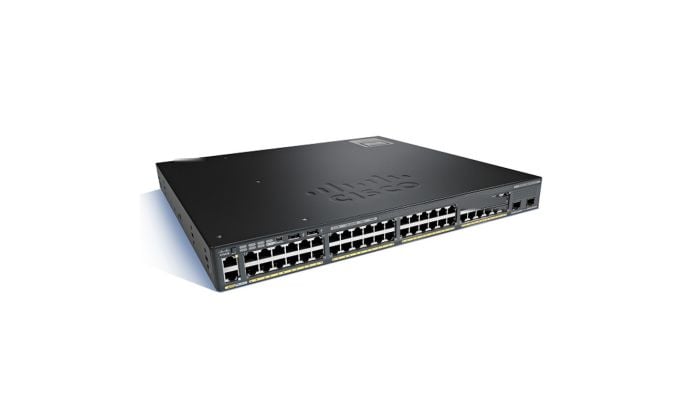
LAN Lite on 48 Gigabit ports is the shape of the Cisco Catalyst 2960X-48TS-LL: 48 access ports, 2 SFP uplink slots at 1 Gbps, no Power over Ethernet, no stacking, and a ceiling of 64 active VLANs. Its forwarding rate of 104.2 Mpps sits close to that of the LAN Base models in the same range, demonstrating that LAN Lite removes features and scale rather than raw switching speed.
104.2 Mpps on a LAN Lite chassis
The forwarding rate on this model is 104.2 Mpps, against 107.1 Mpps on the 48-port LAN Base PoE switch in the same sub-series. That three per cent gap is the clearest available evidence of what the LAN Lite image actually does. It does not slow the switch down. It caps scale and removes features, and on a 48-port chassis those caps land in two specific places.
The first is the VLAN ceiling of 64. On a 24-port switch that is often academic; on a 48-port switch serving twice as many endpoints it is a real constraint, because port count and VLAN count tend to grow together. The second is forwarding bandwidth of 50 Gbps against 108 Gbps on the LAN Base image, which sets a lower ceiling on sustained aggregate throughput than the headline packet rate implies.
| Specification | Catalyst 2960X-48TS-LL |
|---|---|
| Access ports | 48 x 10/100/1000 Ethernet |
| Power over Ethernet | None |
| Uplinks | 2 x SFP, 1 Gbps |
| Aggregate uplink capacity | 2 Gbps |
| Software image | LAN Lite |
| Forwarding rate | 104.2 Mpps |
| Forwarding bandwidth | 50 Gbps |
| Switching bandwidth | 100 Gbps |
| Active VLANs | 64 |
| Stacking | Not supported |
Forty-eight ports behind two uplinks
The uplink ratio is the number to look at hardest on this model. Forty-eight Gigabit access ports sit behind 2 SFP slots at 1 Gbps, for 2 Gbps of aggregate uplink and an oversubscription ratio of 24 to 1. The LAN Base model with four slots halves that to 12 to 1, and the SFP+ model takes it to about 2.4 to 1.
Twenty-four to one is workable for a floor of office desktops that mostly talk to the internet and a file server in bursts. It is not workable for a closet carrying video, imaging, backup traffic or wireless backhaul. Because there is no third slot to add and no SFP+ option, this is a property of the chassis and not something a later purchase can improve.
No stacking, on the model where it would help most
LAN Lite removes FlexStack-Plus entirely, and there is no module, cable or licence that restores it. That is felt more sharply on a 48-port switch than on a 24-port one, because rooms that need 48 ports frequently need 96 or 144 soon afterwards. Three of these switches in a closet are three separate devices with three configurations and three management addresses, where three LAN Base switches would be one logical device.
The operational cost of that shows up in the small things rather than in outages. Every software update is performed three times, every configuration change has to be applied consistently by hand, and every monitoring system carries three entries where it would carry one. None of it is difficult, and all of it accumulates across a site with several closets built the same way.
Where this model genuinely fits is a single-switch room that will stay a single-switch room: a branch office, a small site, a training suite or a temporary installation. In that setting the absence of stacking costs nothing at all, and the density and price make it a sensible choice rather than a compromise.
Where the 48TS-LL sits in the 2960-X range
Reading this model against the LAN Base 48-port data switch and the 24-port LAN Lite switch shows that the image, not the port count, is what sets the ceiling.
| Model | Access ports | Uplinks | Image / VLANs | Forwarding rate |
|---|---|---|---|---|
| 2960X-48TS-LL | 48 Gigabit | 2 x SFP | LAN Lite / 64 | 104.2 Mpps |
| 2960X-48TS-L | 48 Gigabit | 4 x SFP | LAN Base / 1023 | Not published |
| 2960X-24TS-LL | 24 Gigabit | 2 x SFP | LAN Lite / 64 | 68.5 Mpps |
Where powered ports are part of the requirement, the Catalyst 2960X-48FPS-L is the model built for it and carries the LAN Base image as well. For a current-generation platform with the full feature set from the outset, the Catalyst 9300 family is the line to compare and its 48-port model is the direct counterpart.
Lifecycle and support horizon
This model falls under Cisco end-of-life notice EOL13603 for the Catalyst 2960-X product family. End-of-Sale for the hardware was 31 October 2022, the Last Ship Date was 30 January 2023, End of Software Maintenance was 31 October 2023, End of Service Contract Renewal is 29 January 2027, and the Last Date of Support and End of Vulnerability and Security Support both fall on 31 October 2027.
The support calendar is identical to every other member of the family, so it is not a reason to choose or avoid this model. The reasons to choose it are density and cost; the reasons to avoid it are the VLAN ceiling, the uplink ratio and the absence of stacking, and all three are permanent properties of the part number.
Condition, testing and what ships
Units are refurbished enterprise hardware carrying the original Cisco part number. Each is bench tested on receipt, then disassembled, cleaned, inventoried and stored as known-good stock; on order it is rebuilt, configured and tested again immediately before packing. Whole systems including this switch carry the 2-year Enterasource warranty, with free FedEx Ground delivery to the lower 48 states.
SFP transceivers and rack hardware are separate line items unless quoted with the chassis. Cisco software entitlement does not transfer with used hardware, and the LAN Lite image cannot be raised to LAN Base by any licensing action.
Frequently Asked Questions
Is a Catalyst 2960X-48TS-LL slower than the LAN Base 48-port models?
Barely, in packet-forwarding terms. Cisco publishes 104.2 Mpps for this model against 107.1 Mpps for the 48-port LAN Base PoE switch in the same sub-series. Where LAN Lite genuinely bites is scale: forwarding bandwidth of 50 Gbps against 108 Gbps, and a ceiling of 64 active VLANs against 1023.
How oversubscribed is a 2960X-48TS-LL?
About 24 to 1. Forty-eight Gigabit access ports total 48 Gbps against 2 Gbps of aggregate uplink across the two SFP slots. The LAN Base model with four slots halves that ratio and the SFP+ model reduces it to roughly 2.4 to 1. There is no way to add uplink capacity to this chassis later, so the ratio is fixed at purchase.
Can I stack two Catalyst 2960X-48TS-LL switches together?
No. LAN Lite models do not support FlexStack-Plus and cannot be stacked with each other or with anything else. Two of these switches in one closet are two independent devices with two configurations and two management addresses. If stacked management is wanted, the LAN Base version of the same chassis has to be specified instead.
Is 64 VLANs enough for a 48-port access switch?
It depends entirely on the segmentation model, and it is tighter than it looks on a 48-port chassis. Sites that separate voice, data, guest, building management, cameras and printers are consuming six VLANs per site before any per-department or per-tenant split. Count the VLANs the network will carry in three years rather than the number configured on day one.
How does Enterasource test a used 2960X-48TS-LL?
It is bench tested on arrival to confirm the fabric and both uplink slots, then cleaned, inventoried and held as known-good stock. At order time the chassis is rebuilt to specification, configured and tested a second time across all forty-eight access ports immediately before packing. Any defect is recorded against that serial and disclosed on its listing. The catalogue is on the Cisco networking hardware page.