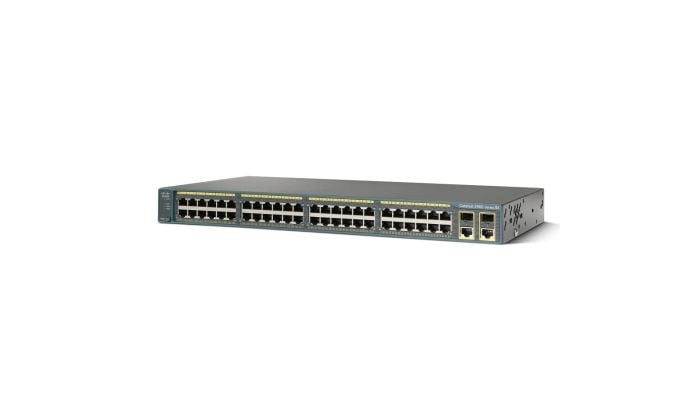
LAN Lite is what separates the Cisco Catalyst 2960-48TC-S from the otherwise identical LAN Base model. It carries the same 48 Fast Ethernet access ports, 2 dual-purpose uplinks and no Power over Ethernet, with a feature set that caps the number of active VLANs below the LAN Base ceiling, irreversibly so, because the image is fixed for the working life of the chassis.
One letter, and it cannot be undone
The final character of the model designation is the entire difference between this switch and the LAN Base version beside it. S is LAN Lite; L is LAN Base. The access ports, the uplink arrangement, the chassis and the Layer 2 forwarding behaviour are identical. What LAN Lite removes is feature depth and scale, and on this generation the image is set at manufacture with no licence or software release that changes it afterwards.
That permanence is the reason it deserves its own section rather than a footnote. On most platforms a feature tier is a licensing decision that can be revisited when requirements grow. Here it is a property of the part number, so a switch bought on price today is a switch with the same ceiling in five years, and the only way past it is to replace the hardware.
| Specification | Catalyst 2960-48TC-S |
|---|---|
| Access ports | 48 x 10/100 Fast Ethernet |
| Power over Ethernet | None |
| Uplinks | 2 dual-purpose, one port active per pair |
| Uplink options per pair | 1 x 10/100/1000 copper or 1 x SFP |
| Software image | LAN Lite |
| Switching layer | Layer 2 |
| Cisco end-of-life notice | EOL9449 |
The uplinks are dual-purpose, which is a count as well as a type
Each of the two uplinks on this chassis contains one 10/100/1000 copper port and one SFP slot, and Cisco documents one port active per pair. Four connectors, two paths. Populating both sides of a pair does not create two links; it simply gives the installer a choice between copper and fibre at the moment of connection, and lets one spare chassis serve either kind of closet.
The practical effect on a 48-port switch is a ratio worth knowing before installation. Forty-eight access ports capped at 100 Mbps produce a theoretical 4.8 Gbps of access-layer traffic against 2 Gbps of usable uplink, which is roughly 2.4 to 1 and entirely comfortable for a closet of desktops and printers. It stops being comfortable the moment the same ports are asked to carry video, imaging or backup traffic, and there is no third uplink to add.
Where LAN Lite is the correct choice
A LAN Lite switch is the right buy in a room whose network is small, stable and unlikely to be re-segmented: a branch office, a workshop, a training suite, a temporary installation or a back-of-house area with a handful of VLANs and no plan to add more. In those settings the feature ceiling is never approached and the image costs nothing at all in practice.
It is the wrong buy anywhere the segmentation model is expected to grow, because the growth arrives incrementally and by different hands. A guest network here, a camera network there, a building-management VLAN added by a contractor, and the ceiling is reached without anyone having decided to approach it. The test is the network in three years, not the configuration on day one.
Where the 48TC-S sits in the classic 2960 range
Two comparisons frame this model: the same chassis on the larger image, and the smallest member of the generation.
| Model | Access ports | Uplinks | Image |
|---|---|---|---|
| 2960-48TC-S | 48 Fast Ethernet | 2 dual-purpose | LAN Lite |
| 2960-48TC-L | 48 Fast Ethernet | 2 dual-purpose | LAN Base |
| 2960-24-S | 24 Fast Ethernet | None | LAN Lite |
Where the requirement includes Gigabit access ports and powered endpoints, the Catalyst 2960S-48FPS-L is a later generation built for that. The current-generation replacement line is the Catalyst 9300 family and its 48-port model is the counterpart at this port count.
Lifecycle and support horizon
Cisco named this model in end-of-life notice EOL9449 covering the classic Catalyst 2960 range. End-of-Sale was 31 October 2014, the Last Ship Date was 29 January 2015, End of Software Maintenance was 31 October 2015, End of Vulnerability and Security Support was 30 October 2017 and the Last Date of Support was 31 October 2019.
Every milestone has passed, so this is a continuity purchase and nothing else. It replaces a failed unit in an installed closet without a configuration migration or a change window, which for a stable Fast Ethernet room is exactly what is wanted. It is not a foundation for new work, and a site standardising on it today should understand that clearly before it does.
Condition, testing and what ships
Units are refurbished enterprise hardware carrying the original Cisco part number. Each is tested on receipt, then disassembled, cleaned, inventoried and returned to stock; at order time it is rebuilt, configured and bench tested a second time before packing. Whole systems including this switch carry the 2-year Enterasource warranty, and delivery is free FedEx Ground to the lower 48 states.
SFP transceivers and rack hardware are quoted separately unless specified with the switch. Cisco software entitlement does not transfer with used hardware, and the LAN Lite image cannot be raised after purchase.
Frequently Asked Questions
What does the S at the end of Catalyst 2960-48TC-S mean?
It marks the LAN Lite software image, the smaller of the two feature sets offered on the classic Catalyst 2960 generation. The equivalent model ending in L carries LAN Base instead. Access ports, uplink arrangement, chassis and Layer 2 forwarding are identical between them, so that single character is the entire functional difference.
Can a Catalyst 2960-48TC-S be upgraded to LAN Base?
No. On this generation the image is set at manufacture and there is no licence, feature key or software release that raises a LAN Lite chassis to the LAN Base feature set. The only route to LAN Base is a different part number, so the decision is permanent at the point of purchase and should be made against the network expected rather than the one configured today.
How many uplink connections can a 2960-48TC-S make at once?
Two. The chassis carries two dual-purpose uplinks, each containing one 10/100/1000 copper port and one SFP slot, with one port active per pair. Four connectors are visible but only two carry traffic. The design exists so a single model suits either a fibre closet or a copper one, not so that four links can be run.
Is the Catalyst 2960-48TC-S a good choice for a growing network?
It is not, and the reason is the fixed image rather than the hardware. LAN Lite caps the feature set and cannot be upgraded, so a network that adds VLANs, segments for guests or cameras, or takes on a second tenant will eventually reach a ceiling it cannot buy past. For a small, stable room with a settled design it remains a sensible and inexpensive choice.
What testing does a used Catalyst 2960-48TC-S get?
It is bench tested on receipt to establish that the switching fabric and both uplink pairs work, then stripped, cleaned and inventoried into stock. At order time it is rebuilt to the requested configuration and tested a second time immediately before packing. Cosmetic grading is recorded per serial and any defect appears on that listing. The full range is on the Cisco networking hardware page.