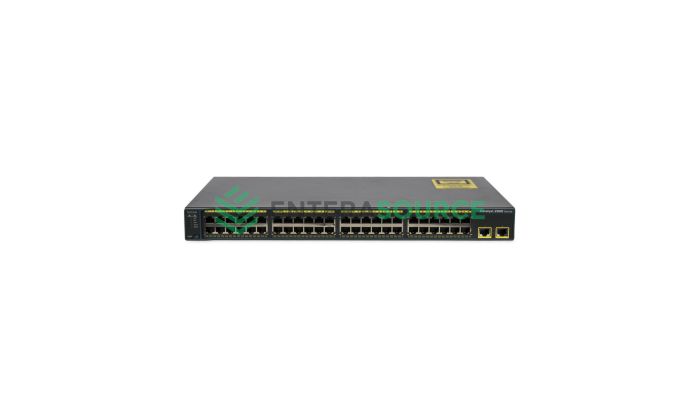
Two copper Gigabit uplinks, no SFP slots at all and no Power over Ethernet are what define the Cisco Catalyst 2960-48TT-L, a 48-port Fast Ethernet access switch running the LAN Base software image. The double T at the end of that designation means that both uplinks are 1000BASE-T copper, consequently this is the classic 2960 for a closet that reaches its distribution switch over copper.
Copper uplinks, and no fibre option at all
Most of the classic Catalyst 2960 range carries dual-purpose uplinks where each pair offers a choice between a copper port and an SFP slot. This model does not. It has 2 fixed 1000BASE-T copper uplinks and no SFP cage anywhere on the chassis, so fibre is not an option and no transceiver is required or possible.
That is a genuine advantage in the right building. A closet reached over structured copper needs no optics, no transceiver compatibility checking and no spares holding for a part that is easy to lose. It is equally a hard limit in the wrong building: a site whose risers are fibre cannot use this switch at the distribution layer at all, and there is no upgrade path because the connector type is fixed in the chassis.
| Specification | Catalyst 2960-48TT-L |
|---|---|
| Access ports | 48 x 10/100 Fast Ethernet |
| Power over Ethernet | None |
| Uplinks | 2 x 1000BASE-T copper |
| SFP slots | None |
| Transceivers required | None |
| Software image | LAN Base |
| Switching layer | Layer 2 |
| Cisco end-of-life notice | EOL9449 |
Two uplinks, both usable
Unlike the dual-purpose models in the same generation, both uplinks here are independent and both can carry traffic at the same time. That gives 2 Gbps of aggregate uplink capacity, or one active path plus a standby where the topology is built for resilience, and it removes the counting ambiguity that dual-purpose ports introduce. What you see on the rear panel is what you can use.
For a resilient design that simplicity is worth something. Two independent copper uplinks can run to two different distribution switches with no transceiver in the path and no shared connector to fail, which is about as few components as an uplink pair can be built from. Fewer parts in the path means fewer things to hold as spares and fewer compatibility questions to answer when one of them needs replacing.
Forty-eight Fast Ethernet ports and what they carry
The access layer here is 10/100, which suits desktops, printers, terminals, controllers and any device that has never needed more. Forty-eight ports at 100 Mbps total 4.8 Gbps against 2 Gbps of copper uplink, a ratio of roughly 2.4 to 1 that keeps the uplink comfortably out of the way in a normal office closet.
The honest limit is the same one that applies to every switch of this generation. Anything that moves video, large files or wireless traffic will find 100 Mbps per port restrictive, and no configuration recovers it. If those workloads are on the roadmap, a Gigabit generation is the correct purchase and this switch is a stopgap rather than a solution.
LAN Base and Layer 2 forwarding
The final L marks the LAN Base image, the larger of the two feature sets on this generation, set at manufacture and not changeable afterwards. Cisco describes the Catalyst 2960-S and 2960 Series as Layer 2 edge switches, and this model behaves accordingly: it forwards on MAC addresses and segments with VLANs, while routing between those VLANs is the job of the distribution switch or router above it.
Where the 48TT-L sits in the classic 2960 range
Its two nearest relatives differ in exactly one thing each: the uplink type, and whether the switch sources power.
| Model | Uplinks | SFP option | PoE |
|---|---|---|---|
| 2960-48TT-L | 2 x 1000BASE-T copper | None | None |
| 2960-48TC-L | 2 dual-purpose, one active per pair | Yes, one per pair | None |
| 2960-48PST-L | 2 copper plus 2 SFP, four active | Yes | Yes |
Where Gigabit access ports and a 10 Gigabit fibre uplink are the requirement, the Catalyst 2960S-48FPD-L is a later generation built for it. The current-generation counterpart at this port count is a Catalyst 9300 48-port model, and the routing tier for a site of this size is normally drawn from the Cisco ISR 4000 family.
Lifecycle and support horizon
Cisco covered this model in end-of-life notice EOL9449 for the classic Catalyst 2960 range. End-of-Sale was 31 October 2014, the Last Ship Date was 29 January 2015, End of Software Maintenance was 31 October 2015, End of Vulnerability and Security Support was 30 October 2017 and the Last Date of Support was 31 October 2019.
The platform is fully retired by Cisco. What sustains demand for this particular model is that copper-uplink closets are common in older buildings and the fixed connector type makes substitution awkward, so a like-for-like replacement is usually the least disruptive answer to a failure. That is a continuity purchase, and it is the only case this page makes for the switch.
Condition, testing and what ships
Refurbished enterprise hardware bearing the original Cisco part number. Each unit is tested on receipt, then disassembled, cleaned, inventoried and returned to stock; on order it is rebuilt, configured and bench tested again before packing, with both copper uplinks verified. Whole systems including this switch carry the 2-year Enterasource warranty, and shipping is free FedEx Ground to the lower 48 states.
No transceivers are needed for this model since it has no SFP slots. Rack hardware is a separate line item unless quoted with the switch, and Cisco software entitlement does not transfer with used hardware.
Frequently Asked Questions
Does a Catalyst 2960-48TT-L have any SFP slots?
No. Both uplinks are fixed 1000BASE-T copper ports and there is no SFP cage anywhere on the chassis, which is what the double T in the designation marks. No transceiver is needed and none can be fitted. A closet that reaches its distribution switch over fibre requires a different model from this generation, because the connector type cannot be changed.
Can both uplinks on a 2960-48TT-L be used at the same time?
Yes, both are independent and both can carry traffic simultaneously, giving 2 Gbps of aggregate uplink capacity. That is different from the dual-purpose models in the same generation, where each uplink pair contains a copper port and an SFP slot with only one active. Here what is visible on the panel is what is usable.
What speed are the access ports on a Catalyst 2960-48TT-L?
All forty-eight run at 10/100 Fast Ethernet. Only the two uplinks reach Gigabit, at 1000BASE-T. This is the original 2960 generation, which predates the Gigabit access layer introduced with the 2960-S sub-series, so any endpoint that needs a Gigabit port requires a later generation of switch rather than a change to this one.
Is a copper-uplink switch a disadvantage?
Only where the building has fibre risers. In a site reached over structured copper it removes transceiver cost, compatibility checking and spares holding entirely, which is a real simplification. The disadvantage is that the choice is permanent: there is no SFP option on this chassis, so a later move to fibre distribution means replacing the switch.
How is a refurbished Catalyst 2960-48TT-L prepared?
The chassis is bench tested on arrival, then stripped, cleaned and inventoried as known-good stock. At order time it is rebuilt to the requested configuration, powered up, configured and tested a second time immediately before packing, with both copper uplinks and all forty-eight access ports checked. Condition is graded per serial and disclosed on the listing. The catalogue is on the Cisco networking hardware page.