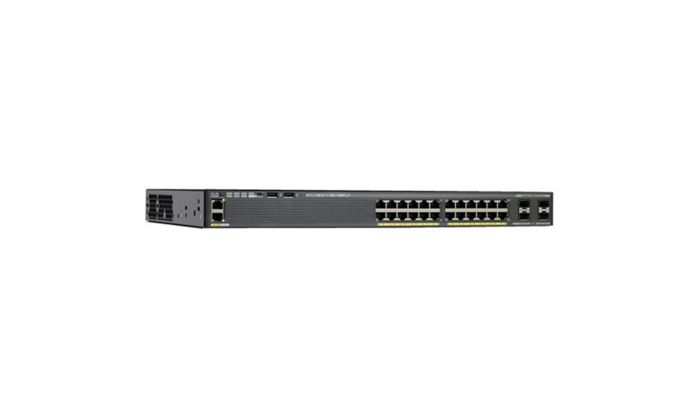
The Cisco Catalyst 2960X-24PD-L combines 24 Gigabit access ports on a 370 W PoE budget with 2 SFP+ uplink slots that run at either 1 or 10 Gbps, in a 1RU chassis carrying the LAN Base image. It is the 24-port model to specify where a closet is small but its uplink is already 10 Gigabit, increasingly the normal shape as buildings retire their Gigabit distribution layers.
A small closet with a large uplink
Most 24-port access switches assume a Gigabit distribution layer and give you four 1 Gbps SFP slots to reach it. This model does the opposite: 2 SFP+ slots capable of 10 Gbps each, for 20 Gbps of aggregate uplink behind 24 access ports. That is a deliberately generous ratio and it exists because small closets increasingly sit behind the same 10 Gigabit core as large ones.
The SFP+ slots also accept 1 Gbps optics, which matters more than the headline. A site can commission the switch on the fibre and transceivers it already owns and move to 10 Gigabit later without touching the closet again. That flexibility is the practical reason to specify a D model even where the distribution layer has not yet been upgraded.
| Specification | Catalyst 2960X-24PD-L |
|---|---|
| Access ports | 24 x 10/100/1000 Ethernet |
| PoE budget | 370 W combined |
| Ports at the 30 W PoE+ ceiling | 12 |
| Ports at the 15.4 W PoE ceiling | 24 |
| Uplinks | 2 x SFP+, 1/10 Gbps |
| Software image | LAN Base |
| Forwarding bandwidth | 108 Gbps |
| Switching bandwidth | 216 Gbps |
| Active VLANs | 1023 |
| Stacking | FlexStack-Plus, 80 Gbps, 8 members |
| Rack height | 1RU, 1.75 in |
What the 370 W budget covers
Three hundred and seventy watts is shared across all 24 access ports and drawn on demand. Cisco's published maximums for this model are 12 ports at the full 30 W an IEEE 802.3at PoE+ endpoint may draw, and 24 ports at the 15.4 W ceiling of standard PoE. Neither is a setting; both are the budget divided by the class. A room of telephones will fill every port with watts to spare, while a dozen outdoor access points will exhaust the pool first.
Stacking at 80 Gbps, and what it will join
FlexStack-Plus on the 2960-X runs at 80 Gbps across up to eight members on the LAN Base image, four times the 20 Gbps a 2960-S FlexStack reaches. The stack is managed as one logical switch with a single configuration and a single address. A separate FlexStack-Extended option covers longer-distance and floor-to-floor stacking at 40 Gbps with the same eight-member ceiling.
Cross-generation compatibility runs in one direction only. FlexStack-Plus is backward compatible with FlexStack, so this switch will stack with a Catalyst 2960-S or 2960-SF LAN Base switch fitted with a FlexStack module, at a reduced 40 Gbps and a limit of four members. It will not stack with a Catalyst 2960-XR in either direction, and that is worth confirming before a mixed order is placed.
Where the 24PD-L sits in the 2960-X range
Among the 24-port models the two variables are uplink media and PoE budget. This one takes the 10 Gigabit uplinks and the mid-sized power pool, which is the combination a small closet with powered endpoints and a modern core actually needs.
| Model | Access ports | PoE budget | Uplinks | Stacking |
|---|---|---|---|---|
| 2960X-24PD-L | 24 Gigabit | 370 W | 2 x SFP+, 10 Gbps | FlexStack-Plus |
| 2960X-24PS-L | 24 Gigabit | 370 W | 4 x SFP, 1 Gbps | FlexStack-Plus |
| 2960X-24TD-L | 24 Gigabit | None | 2 x SFP+, 10 Gbps | FlexStack-Plus |
Where the same uplink shape is needed on 48 ports and a full 740 W budget, the Catalyst 2960X-48FPD-L is the direct equivalent. The current-generation counterpart to this switch is a Catalyst 9300 24-port model, and the routing tier that usually sits above a closet like this is the Cisco ISR 4000 family.
Lifecycle and support horizon
Cisco covered the Catalyst 2960-X product family in end-of-life notice EOL13603, and this model is named in it. End-of-Sale for the hardware was 31 October 2022 and the Last Ship Date was 30 January 2023. The Last Date of Support for the hardware is 31 October 2027 and End of Vulnerability and Security Support falls on the same date, with End of Service Contract Renewal on 29 January 2027.
That combination is the entire refurbished case for this generation. Cisco has stopped selling the hardware but has not stopped supporting it, and the only route to a unit in between those two facts is the secondary market. It is worth checking the specific model against the notice rather than assuming family coverage, because one 24-port member of this sub-series is excluded from EOL13603 and carries its own separate announcement.
Condition, testing and what ships
Units are refurbished enterprise hardware carrying the original Cisco part number. Each switch is tested on receipt, then disassembled, cleaned, inventoried and returned to stock; on order it is picked, assembled, configured to the requested specification and bench tested again before packing. Whole systems including this switch carry the 2-year Enterasource warranty, with free FedEx Ground delivery to the lower 48 states.
SFP+ transceivers, FlexStack-Plus modules and stacking cables are separate line items unless quoted with the chassis. Cisco software entitlement is not included and does not transfer with used hardware.
Frequently Asked Questions
Will the SFP+ slots on a 2960X-24PD-L take 1 Gigabit transceivers?
Yes. The uplink slots on the D models run at either 1 or 10 Gbps, so a Gigabit optic is a supported fit and the switch can be commissioned on an existing fibre plant. That dual-rate capability is the strongest argument for buying a D model even at a site whose distribution layer is still Gigabit on the day of installation, because the switch does not have to be replaced when the core moves.
How many PoE devices will a Catalyst 2960X-24PD-L run?
Twelve at the full 30 W an IEEE 802.3at PoE+ endpoint may draw, or all 24 at the 15.4 W ceiling of standard PoE, from a shared 370 W pool. Real closets fall between the two because desk telephones draw far less than the maximum. Total the class draw of the endpoints rather than assuming the port count is the constraint.
What does the D mean in the 2960X-24PD-L designation?
It marks the uplink type. Across the 2960-X sub-series a trailing D denotes 2 SFP+ slots capable of 10 Gbps, and a trailing S denotes 4 SFP slots fixed at 1 Gbps. The letters before it carry the power budget, where P on a 24-port model means the 370 W pool and T means a data-only chassis with no Power over Ethernet at all.
Can a 2960X-24PD-L stack with a Catalyst 2960-S?
Yes, provided both switches carry the LAN Base image and both have their stacking modules fitted, because FlexStack-Plus is backward compatible with FlexStack. The mixed stack runs at 40 Gbps with a maximum of four members instead of the 80 Gbps and eight members a pure 2960-X stack reaches. Stacking with a 2960-XR is not supported in either direction.
What condition are refurbished 2960X-24PD-L switches supplied in?
Cleaned, tested and configured to the specification on the order. Every chassis is bench tested twice, once on arrival to prove the hardware and again after reassembly immediately before packing, with the PoE stage and both uplink slots exercised. Cosmetic wear is graded per serial and any defect is published on that unit's listing. The wider range is on the Cisco networking hardware page.