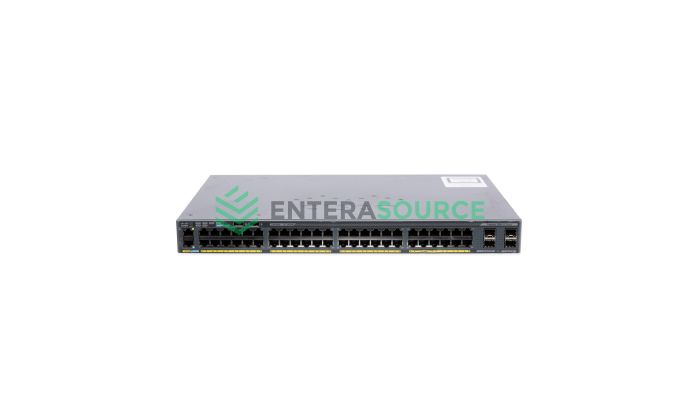
The Cisco Catalyst 2960X-48TS-L provides 48 Gigabit access ports and 4 SFP uplink slots at 1 Gbps, running the LAN Base image with FlexStack-Plus stacking and no Power over Ethernet. Against the SFP+ model beside it in the catalogue the only difference is the uplink media and nothing else, consequently the choice rests on whether the building riser still carries Gigabit fibre.
The straight replacement for a 2960-S data closet
This is the model most often bought to replace an ageing 48-port data switch, and the reason is that nothing about the closet has to change. The port count is the same, the uplink media is the same 4 SFP slots at 1 Gbps, the rack space is the same 1RU and the fibre already terminated in the room still works. What changes is behind the front panel: 1023 active VLANs instead of 255, 108 Gbps of forwarding bandwidth instead of 88, and a stack fabric running at 80 Gbps instead of 20.
That is an unusually clean upgrade path. Most generational replacements force a change to the cabling, the optics or the rack layout. Here the switch drops into the same position with the same optics and delivers four times the stack bandwidth and four times the VLAN ceiling.
| Specification | Catalyst 2960X-48TS-L |
|---|---|
| Access ports | 48 x 10/100/1000 Ethernet |
| Power over Ethernet | None |
| Uplinks | 4 x SFP, 1 Gbps |
| Aggregate uplink capacity | 4 Gbps |
| Software image | LAN Base |
| Forwarding bandwidth | 108 Gbps |
| Switching bandwidth | 216 Gbps |
| Active VLANs | 1023 |
| Stacking | FlexStack-Plus, 80 Gbps, 8 members |
| Rack height | 1RU, 1.75 in |
Four Gigabit uplinks against two 10 Gigabit ones
The choice between this model and its SFP+ sibling is genuinely about topology rather than about better and worse. Four slots at 1 Gbps deliver 4 Gbps of aggregate capacity across up to four diverse paths. Two SFP+ slots deliver up to 20 Gbps across two. A closet of desktops that has never saturated a Gigabit uplink gains more from path diversity than from headroom it will not use.
The situations that reverse the answer are specific and recognisable: the closet aggregates other switches, it carries wireless backhaul for a dense deployment, or it serves users who routinely move large files. Any of those makes the SFP+ model the correct specification, and the decision cannot be revisited later because the slot type is fixed in the chassis.
Stacking and cross-generation compatibility
FlexStack-Plus gives this switch 80 Gbps of stack throughput across up to eight members, managed as one logical device. It is backward compatible with the FlexStack fabric on the 2960-S and 2960-SF, so a phased replacement can run a mixed stack during the transition, at a reduced 40 Gbps and a four-member ceiling. Once the last previous-generation member is removed the stack returns to 80 Gbps and eight members without reconfiguration.
A 2960-XR will not stack with this switch in either direction. That is worth stating because the XR is otherwise the closest relative in the catalogue and is easily assumed to be compatible.
Stack members also keep their own uplinks, which is the detail that makes a stacked data closet resilient rather than merely tidy. Spreading four uplinks across two members means the stack survives losing an entire chassis with its path to the distribution layer intact, and it does so under a single configuration that does not have to be rewritten when a member is swapped.
Where the 48TS-L sits in the 2960-X range
Among the 48-port data-only models the variables are uplink media and software image, and this one sits at the top of both ladders.
| Model | Uplinks | Image / VLANs | Stacking | PoE |
|---|---|---|---|---|
| 2960X-48TS-L | 4 x SFP, 1 Gbps | LAN Base / 1023 | FlexStack-Plus | None |
| 2960X-48TD-L | 2 x SFP+, 10 Gbps | LAN Base / 1023 | FlexStack-Plus | None |
| 2960X-48TS-LL | 2 x SFP, 1 Gbps | LAN Lite / 64 | None | None |
Where the same closet also has to power telephones or access points, the Catalyst 2960X-48FPS-L is the powered model with an identical uplink layout. The current-generation counterpart is a Catalyst 9300 48-port model, and where a refresh takes in routing as well the Cisco ISR 4000 family is the matching tier.
Lifecycle and support horizon
This model is named in Cisco end-of-life notice EOL13603 for the Catalyst 2960-X product family. End-of-Sale for the hardware was 31 October 2022 and the Last Ship Date was 30 January 2023, with End of Software Maintenance on 31 October 2023. The Last Date of Support and End of Vulnerability and Security Support are both 31 October 2027, and End of Service Contract Renewal is 29 January 2027.
Buying refurbished inside a support window Cisco has not yet closed is a materially different proposition from buying a platform that is fully retired, and this generation still sits inside that window. For sites replacing 2960-S hardware the practical effect is that the replacement carries a longer runway than the switch it displaces.
Condition, testing and what ships
Refurbished enterprise hardware bearing the original Cisco part number. Testing runs on receipt and again on despatch, with disassembly, cleaning, inventory, assembly and configuration between the two passes. Whole systems including this switch carry the 2-year Enterasource warranty, and shipping is free FedEx Ground to the lower 48 states.
SFP transceivers, FlexStack-Plus modules and stacking cables are quoted separately unless specified with the switch. Cisco software licensing is not included with used hardware and does not transfer with it.
Frequently Asked Questions
Can a Catalyst 2960X-48TS-L replace a 2960-S data switch without changing the closet?
Yes, and that is its most common use. Port count, uplink media, slot type and rack height all match the previous generation, so the existing fibre and optics continue to work in the same position. What improves is the VLAN ceiling, which rises from 255 to 1023, the forwarding bandwidth, which rises from 88 Gbps to 108 Gbps, and the stack fabric, which rises from 20 Gbps to 80 Gbps.
Should I choose 4 SFP uplinks or 2 SFP+ uplinks on a 48-port 2960-X?
Choose four Gigabit slots when path diversity matters more than raw capacity, which is the normal case for a closet of desktops and telephones. Choose two SFP+ slots when the closet aggregates other switches, carries dense wireless backhaul or serves large file transfers. The slot type is fixed in the chassis and cannot be changed afterwards, so the decision is permanent.
Will a mixed stack of 2960-X and 2960-S switches work during a migration?
It will, provided every member carries the LAN Base image and the correct stacking module, because FlexStack-Plus is backward compatible with FlexStack. The mixed stack runs at 40 Gbps with a maximum of four members. When the last previous-generation member is removed the remaining stack returns to 80 Gbps and eight members with no reconfiguration required.
Does a 2960X-48TS-L stack with a Catalyst 2960-XR?
No, in neither direction and under no configuration. The 2960-XR forms its own stacking domain and joins only with other 2960-XR switches. This catches people out because the XR is otherwise the nearest relative in the catalogue, so a mixed order intended to build one stack will produce two independent switches instead.
What condition are refurbished 2960X-48TS-L switches supplied in?
Cleaned, tested and configured to the order. The inbound pass on receipt proves the switching fabric and all four uplink slots; the chassis is then stripped, cleaned and inventoried into stock. The outbound pass follows reassembly immediately before packing. Cosmetic wear is graded against the individual unit and any defect is written into its listing. The full range is on the Cisco networking hardware page.