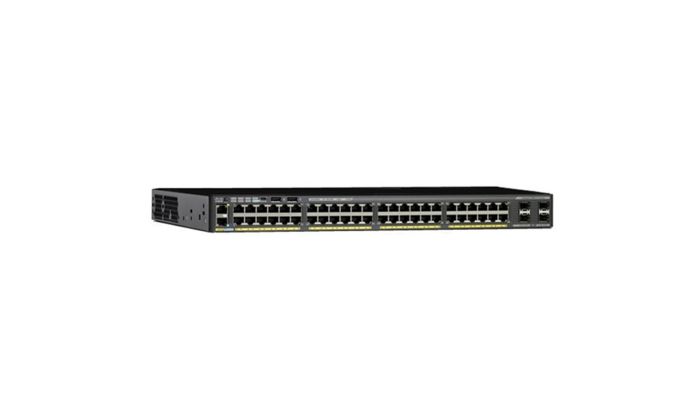
The Cisco Catalyst 2960X-48TD-L is a 48-port Gigabit switch with no Power over Ethernet and 2 SFP+ uplink slots that run at 1 or 10 Gbps, on the LAN Base image with FlexStack-Plus stacking. It is the densest data-only model in the sub-series and it uplinks at 10 Gigabit over two SFP+ slots, traditionally the combination an aggregation closet or a small server room asks for.
Forty-eight ports, 20 Gbps out, no power stage
This switch pairs the highest access-port count in the sub-series with the faster of the two uplink options and removes Power over Ethernet entirely. Forty-eight Gigabit access ports total 48 Gbps of theoretical access-layer capacity against up to 20 Gbps of uplink across the two SFP+ slots, which is roughly 2.4 to 1. For a data closet or a rack of servers and appliances that is a comfortable ratio and considerably better than the four Gigabit uplinks a comparable switch would offer.
The slots are dual-rate, so 1 Gbps optics are supported and a site can install the switch behind a Gigabit core and move it to 10 Gigabit later without replacing anything. On a data-only chassis that flexibility is worth more than usual, because these units routinely stay in service through two or three refreshes of the equipment around them.
| Specification | Catalyst 2960X-48TD-L |
|---|---|
| Access ports | 48 x 10/100/1000 Ethernet |
| Power over Ethernet | None |
| Uplinks | 2 x SFP+, 1/10 Gbps |
| Aggregate uplink capacity | 20 Gbps |
| Software image | LAN Base |
| Forwarding bandwidth | 108 Gbps |
| Switching bandwidth | 216 Gbps |
| Active VLANs | 1023 |
| Stacking | FlexStack-Plus, 80 Gbps, 8 members |
| Rack height | 1RU, 1.75 in |
Behind the front panel the LAN Base image supplies 1023 active VLANs, 108 Gbps of forwarding bandwidth and 216 Gbps of switching bandwidth in a 1RU chassis, which is the same software platform as the powered models in this sub-series.
Why a data-only switch fits a server room
Server and appliance racks almost never need Power over Ethernet, and they do need port density, VLAN headroom and a fast path out of the rack. This model provides all three without a power controller, which means less heat inside a cabinet that is usually already fighting for airflow and one fewer subsystem to fail in a location where a failure is more disruptive than in a wiring closet.
The 1023-VLAN ceiling matters more here than in an access closet too. Virtualised hosts, storage networks, out-of-band management and per-tenant segmentation all consume VLANs quickly, and a switch capped at 64 would be a poor fit in exactly the environments where this one is most useful.
Stacking as a density strategy
FlexStack-Plus runs at 80 Gbps across up to eight members on the LAN Base image and presents the whole stack as one logical switch with one configuration and one management address. Eight of these switches stacked is 384 access ports and 16 SFP+ slots, which is a serious amount of capacity managed as a single device. Backward compatibility with the 2960-S and 2960-SF FlexStack fabric is supported at 40 Gbps with a four-member limit; a 2960-XR will not join in either direction.
Modules and stacking cables are separate parts and are not supplied with the chassis, so a stack build should be quoted as a whole rather than assembled from assumptions about what arrives in the box.
Where the 48TD-L sits in the 2960-X range
The three models below differ in uplink media and power. This one takes the fastest uplinks and no power at all, which is the specific corner of the matrix a server room usually wants.
| Model | Access ports | PoE budget | Uplinks | Image |
|---|---|---|---|---|
| 2960X-48TD-L | 48 Gigabit | None | 2 x SFP+, 10 Gbps | LAN Base |
| 2960X-48TS-L | 48 Gigabit | None | 4 x SFP, 1 Gbps | LAN Base |
| 2960X-48LPD-L | 48 Gigabit | 370 W | 2 x SFP+, 10 Gbps | LAN Base |
Where the same 10 Gigabit uplink shape is needed with a full 740 W power budget, the Catalyst 2960X-48FPD-L is the model to specify. The current-generation successor line is the Catalyst 9300 family, whose 48-port model is the direct counterpart to this chassis at a higher power and uplink tier.
Lifecycle and support horizon
Cisco end-of-life notice EOL13603 covers the Catalyst 2960-X product family and names this model. End-of-Sale for the hardware was 31 October 2022, the Last Ship Date was 30 January 2023 and End of Software Maintenance was 31 October 2023. The Last Date of Support and End of Vulnerability and Security Support both fall on 31 October 2027, with End of Service Contract Renewal on 29 January 2027.
Several years of remaining Cisco hardware support on a product Cisco no longer ships is the whole refurbished argument, and it applies with particular force to a data-only chassis. With no power supply working against a full PoE load and no power controller to age, units of this type frequently arrive in condition that is difficult to distinguish from new.
Condition, testing and what ships
Every unit is refurbished enterprise hardware carrying the original Cisco part number. Each chassis is tested on receipt, then disassembled, cleaned, inventoried and returned to stock; on order it is rebuilt, configured to the requested specification and bench tested a second time immediately before packing. Whole systems including this switch carry the 2-year Enterasource warranty, with free FedEx Ground delivery to the lower 48 states.
SFP+ transceivers, FlexStack-Plus modules and stacking cables are separate line items unless quoted with the chassis. Cisco software entitlement is not included and does not transfer with used hardware.
Frequently Asked Questions
Is a Catalyst 2960X-48TD-L suitable for a server rack rather than a wiring closet?
It is one of the better fits in the sub-series for that role. Servers and appliances need port density, VLAN headroom and a fast exit from the rack, none of which require Power over Ethernet. Forty-eight Gigabit ports behind up to 20 Gbps of SFP+ uplink, with 1023 active VLANs on the LAN Base image, covers all three without a power stage adding heat to the cabinet.
What is the aggregate uplink capacity of a 2960X-48TD-L?
Up to 20 Gbps across the two SFP+ slots when both are populated with 10 Gigabit transceivers. The slots are dual-rate and will also accept 1 Gbps optics, in which case the aggregate is 2 Gbps. That flexibility lets a site commission the switch against an existing Gigabit fibre plant and raise the uplinks later without replacing the chassis.
How many ports does a full stack of 2960X-48TD-L switches provide?
Three hundred and eighty-four access ports across the maximum of eight members, plus sixteen SFP+ uplink slots, all managed as a single logical switch with one configuration and one address. FlexStack-Plus runs that stack at 80 Gbps. The stacking modules and cables are separate parts and are not included with the chassis.
Does the 2960X-48TD-L have any PoE capability at all?
None. There is no power controller and no PoE budget on this model, which is what the T in the designation marks throughout the sub-series. Adding Power over Ethernet later is not possible on a T chassis, so any endpoint that will ever need power behind this switch has to be served by an injector or a separate powered switch.
What checks does a refurbished 2960X-48TD-L receive before despatch?
Two full bench passes. The first, on receipt, establishes that the switching fabric and both uplink slots are sound. The chassis is then cleaned, inventoried and held as known-good stock. The second follows reassembly and configuration to the order, immediately before packing, and covers all forty-eight access ports. Condition is graded per serial and disclosed on the listing. The catalogue is on the Cisco networking hardware page.